
Executive Summary: A Pivotal Move for Financial Stability
In a significant development for Colombia’s macroeconomic outlook, the International Monetary Fund (IMF) has officially expressed its support for the Colombian government’s latest fiscal initiative. The "Economic Rescue Law," a comprehensive package aimed at rectifying deep-seated imbalances in public finances, has been received as a necessary, albeit challenging, step toward ensuring the long-term sustainability of the nation’s accounts.
Julie Kozack, Director of the Communications Department at the IMF, underscored the importance of the initiative during a recent press briefing. "We celebrate the decision of the Colombian authorities to present an important fiscal package before Congress. This constitutes a significant step toward addressing the fiscal challenges inherited by the new administration and strengthening Colombia’s fiscal sustainability," Kozack noted.

This endorsement comes at a critical juncture, as the government, led by Minister of Finance Miguel Gómez Martínez and Vice President José Manuel Restrepo, attempts to navigate a landscape defined by high debt-servicing costs and a growing fiscal deficit that threatens the nation’s creditworthiness.
Chronology of the Crisis and the Legislative Response
The urgency behind the 106-article legislative proposal is rooted in a series of economic pressures that have mounted throughout 2026.

- Early 2026: Initial assessments by the incoming administration revealed a structural deficit exacerbated by a heavy debt burden, with nearly one-third of tax revenue being diverted to cover interest payments.
- October 20, 2026: Formal discussions regarding the 2027 General Budget concluded, setting the expenditure limit at 634.9 trillion pesos, highlighting the immense gap between state income and expenditure.
- October 29, 2026: Minister of Finance Miguel Gómez Martínez and Vice President José Manuel Restrepo formally radicated the "Economic Rescue Law" (Project 477 of 2026) before the Chamber of Representatives.
- Early November 2026: The IMF issues its public backing of the initiative, providing a much-needed signal of confidence to international markets and credit rating agencies.
The government’s decision to move quickly is not accidental. With the current legislative session scheduled to conclude on December 16, 2026, the administration is facing a narrow window to secure the passage of these reforms. Failure to act, as hinted by senior government officials, could place the country at risk of a sovereign default—a scenario the current administration is desperate to avoid.
Supporting Data: The Anatomy of the Fiscal Gap
The fiscal reality facing Colombia is stark. According to government projections presented during the introduction of the law, the fiscal deficit could reach as high as 9.4% of the Gross Domestic Product (GDP) in 2027 if no corrective action is taken.

The 634.9 trillion-peso budget for 2027 is distributed as follows:
- Operating Expenses (Funcionamiento): 391.38 trillion pesos.
- Debt Service: 155.43 trillion pesos.
- Investment: 88.14 trillion pesos.
The "one-in-three" rule mentioned by Vice President Restrepo—where one out of every three pesos collected in taxes is consumed by interest payments—serves as the primary catalyst for the proposed reforms. The administration argues that this trend is unsustainable and requires a drastic recalibration of how the state collects and spends its money.

The Strategy for Adjustment
The government’s plan relies on a dual-pronged approach, focusing primarily on efficiency rather than tax hikes:
- Expenditure Reduction (70% of the target): The bulk of the effort involves streamlining state operations, a rigorous review of existing contracts, and the elimination of redundant bureaucratic structures.
- Revenue Generation (30% of the target): This component includes anti-evasion measures, the curbing of contraband, and the strategic sale of underperforming state-owned assets.
Official Responses and Political Maneuvering
The introduction of the bill has triggered intense debate within the halls of the Colombian Congress. While the IMF’s support provides a layer of international credibility, the domestic political reality is far more complex.
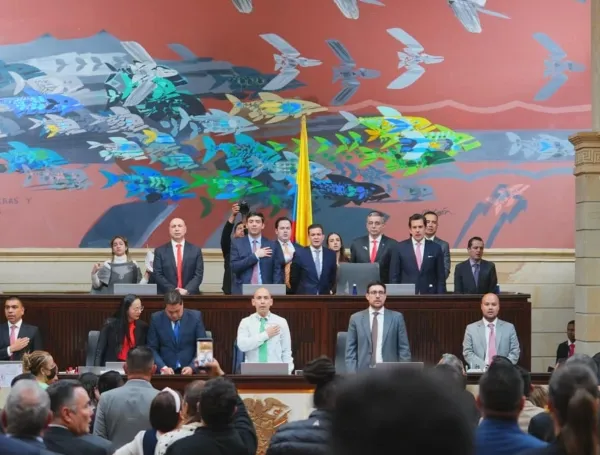
Minister Miguel Gómez Martínez has been vocal in defending the necessity of the 106-article package, framing it as a "surgical operation" to save the economy from long-term stagnation. In contrast, opposition members have raised concerns regarding the proposed changes to the Value Added Tax (VAT) and the potential impact on lower-income households.
Interestingly, the government has proposed a "carrot" to offset the "stick" of fiscal austerity: a reduction in the general corporate income tax rate. The plan suggests lowering the rate from the current 35% to 33% in 2027, and further down to 31% by 2028. This move is designed to stimulate investment, encourage formalization, and support the growth of micronegovernments and SMEs.

Implications: The Road Ahead
The implications of Project 477 extend far beyond the immediate budget cycle. Should the law pass in its current form, it would signal to global investors that Colombia is committed to institutionalizing fiscal discipline, potentially stabilizing the peso and lowering the risk premium on government bonds.
The Legislative Hurdle
The bill must now navigate the economic committees before reaching the floor of the Senate and the Chamber of Representatives. Key areas of contention include:

- The Distribution of the Adjustment: How much burden should be borne by the taxpayer versus the state’s own internal operating budget?
- VAT Modifications: The reach and application of the VAT will likely be the most heavily debated section of the project.
- Privatization vs. Efficiency: The sale of state assets is expected to face resistance from labor unions and political factions that favor state control of certain sectors.
IMF’s Role: Caution vs. Support
While the IMF has "celebrated" the presentation of the bill, it is important to note that the organization’s endorsement is limited to the intent and the direction of the reform. The IMF has not yet weighed in on the specific technical details or the social feasibility of every tax measure contained within the 106 articles. Their support serves as a vote of confidence in the administration’s strategy, but it does not guarantee that the current plan will be sufficient to fully bridge the deficit gap without further adjustments in the coming years.
Conclusion
The coming weeks will be decisive for the Colombian economy. The administration’s ability to build consensus within a fractured Congress will determine whether this "Economic Rescue Law" becomes the foundation for a sustainable future or another failed attempt at fiscal reform.

As of early November 2026, the government remains optimistic, betting that the fear of a potential "default" will galvanize the political class to set aside partisan interests in favor of national stability. The eyes of the international financial community remain firmly fixed on Bogotá, waiting to see if Colombia can successfully navigate this delicate transition.
For the citizens of Colombia, the outcome of these debates will have long-term consequences, impacting everything from employment opportunities to the cost of living and the availability of public services. The government’s promise of "fiscal efficiency" is now on trial, and the legislative calendar offers little room for error.

Reporting by Laura Lesmes Díaz. For more in-depth coverage of Colombian economic policy, follow our weekly newsletter and updates on our official social media channels.