Unveils Record $42.7 Trillion District Budget for 2027: Heavy Investment in Mobility and Education Spearhead the Capital’s Financial Roadmap
BOGOTÁ — In a comprehensive financial blueprint aimed at consolidating major infrastructure projects, expanding educational opportunities, and securing long-term economic stability, the District Secretariat of Treasury (Secretaría de Hacienda) has officially unveiled Bogotá’s proposed budget for the fiscal year 2027. Totalling an unprecedented $42.7 trillion, the financial plan reflects a 4.2% growth compared to the active budget registered at the close of October 2026.
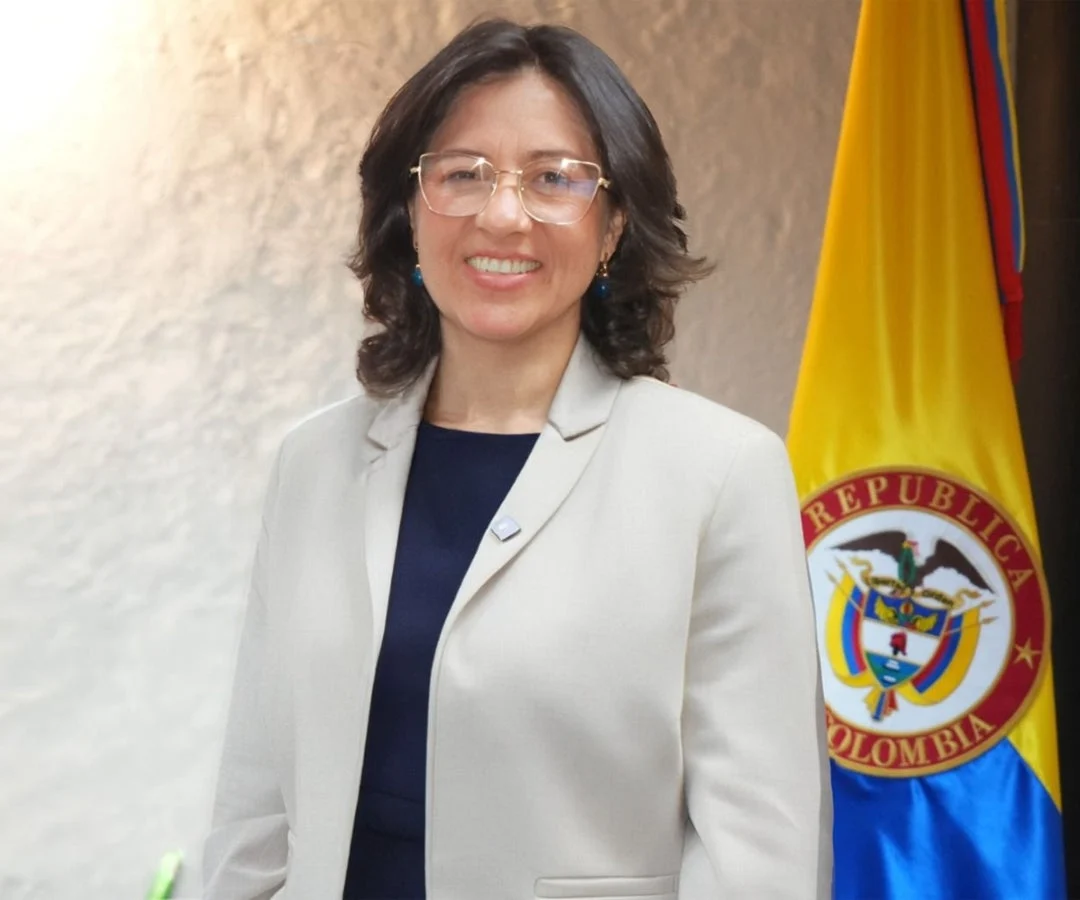
The announcement, led by Bogotá’s Secretary of Treasury, Ana María Cadena, underscores a strategic reallocation of public funds designed to prioritize physical transformation and social development. Under the proposed framework, the vast majority of the capital’s resources—an overwhelming 77.9%—will be funneled directly into investment projects. Meanwhile, 13.3% has been earmarked for institutional functioning, and 8.8% is designated to service the district’s public debt, which stood at $15.8 trillion as of September 2026.
As the city continues to navigate complex logistical and socio-economic demands, the 2027 budget positions mobility and education as the twin pillars of urban progress. Together, these two sectors absorb nearly half of the entire district purse, signaling a definitive commitment by the local administration to deliver on long-awaited structural reforms and transformative public works.
Main Facts
The 2027 budget proposal is structured around several macroeconomic highlights and core expenditure allocations that define Bogotá’s fiscal strategy for the upcoming year:
- Total Budget Volume: The district budget is fixed at $42.7 trillion, marking a 4.2% nominal expansion over the previous year’s baseline.
- Resource Distribution: Investment claims the lion’s share at 77.9%, followed by operational expenditures at 13.3%, and debt service obligations at 8.8%.
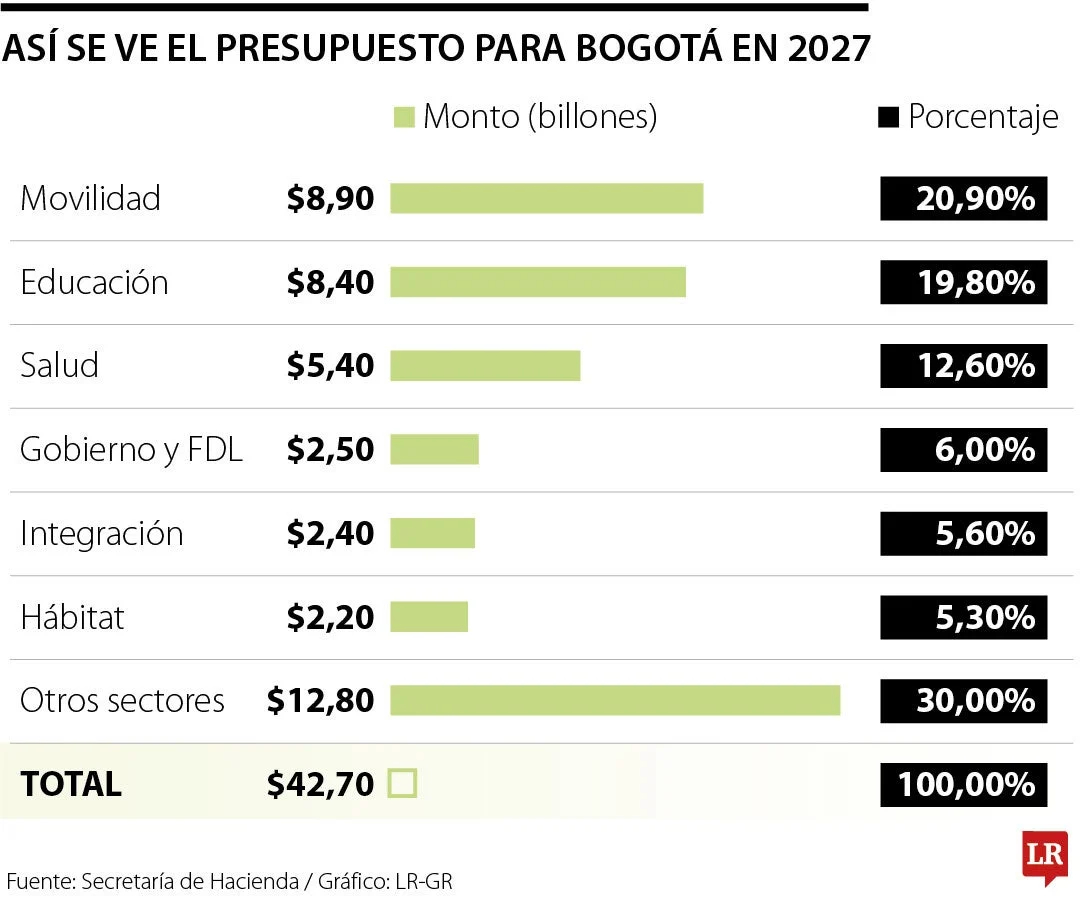
- Mobility Dominance: The mobility sector secures the largest single slice of the district allocation, receiving $8.9 trillion (20.9% of the total funds). This capital will finance critical mass-transit initiatives, including the First Line of the Bogotá Metro, feeder trunk lines, the Calle 13 corridor, the Carrera Séptima project, and major road rehabilitation.
- Educational Advancement: Education follows closely behind, capturing $8.4 trillion (19.8% of the total budget). The funding guarantees the construction and restoration of schools, continuous school feeding programs, and higher education access for thousands of youths.
- Four-Year Cumulative Investment: With the inclusion of the 2027 projections, the total cumulative investment programmed for the 2024–2027 governmental period will reach $115.1 trillion (calculated in constant 2024 pesos), surpassing the initial $114.1 trillion target established in the Plurianual Investment Plan.
- Revenue Projections: Current revenues for Bogotá are projected to hit $32.2 trillion in 2027, representing a notable 12.2% increase compared to the active budget.
Chronology of the Budgetary Process
The formulation and presentation of the 2027 fiscal package are the culmination of a rigorous, multi-stage planning cycle led by the District Secretariat of Treasury in coordination with municipal entities, sector secretariats, and financial monitors.
Phase 1: Mid-Term Fiscal Review (Early 2026)
Throughout the first half of 2026, the District Secretariat of Treasury conducted comprehensive audits of ongoing public works, tax collection efficiencies, and macroeconomic indicators. This evaluation incorporated the performance metrics of the city’s public debt—which reached $15.8 trillion by September 2026—ensuring that upcoming debt-servicing schedules would not compromise the capital’s credit rating or restrict liquidity for new investments.
Phase 2: Sectoral Negotiations and Resource Allocation (Mid-2026)
During the third quarter of 2026, sector heads submitted their respective budgetary requests. The negotiations prioritized projects already underway to prevent fiscal stalling. Sectors such as Mobility and Education presented exhaustive technical portfolios demonstrating high social and economic return on investment. Treasury officials balanced these demands against conservative revenue forecasts, factoring in expected returns from municipal dividends, asset optimization, and national transfers.
Phase 3: Official Presentation of the Bill (Late November 2026)
On November 23, 2026, Treasury Secretary Ana María Cadena officially unveiled the $42.7 trillion project to the public and the media. This milestone marked the formal submission of the bill into the legislative pipeline, initiating the mandatory review process by the Bogotá City Council (Concejo de Bogotá), where local lawmakers will debate, scrutinize, and vote on the final provisions ahead of the 2027 fiscal year.
Supporting Data: Where the Money Comes From and Where It Goes
A granular examination of the financial mechanics behind the 2027 budget reveals a diversified revenue matrix designed to ensure fiscal resilience against economic volatility.
Revenue Breakdown ($42.7 Trillion Total)
To cover the expansive $42.7 trillion spending plan, the district relies on a combination of tax receipts, national contributions, commercial dividends, and credit operations:
- Local Taxes ($18.7 trillion): Property taxes, industry and commerce taxes (ICA), and vehicle surcharges remain the bedrock of municipal self-sufficiency.
- National Transfers ($10.6 trillion): Funds transferred from the central government, primarily designated for education, health, and general-purpose municipal development under national mandates.
- Dividends, Surpluses, and Asset Optimization ($3.9 trillion): Financial returns generated by district-owned enterprises, public utilities, and strategic asset management.
- Financial Yields and Prior-Year Balances ($3.7 trillion): Capital carried over from unexecuted accounts of previous fiscal periods and interest accrued on district cash reserves.
- Contributions, Fees, Fines, and Penalties ($2.9 trillion): Regulatory levies, administrative fines, transit penalties, and specialized public contributions.
- Debt Resources ($2.9 trillion): New credit disbursements and loan authorizations utilized to bridge capital expenditure requirements for long-term mega-projects.
Expenditure Allocation Breakdown
The targeted deployment of these funds reflects clear public policy priorities aimed at transforming urban logistics and human capital:
- Mobility ($8.9 trillion / 20.9%): The allocation is heavily weighted toward high-impact infrastructure. Aside from the First Line of the Bogotá Metro, resources are secured for feeder trunk systems that connect peripheral neighborhoods to the trunk lines, the complex civil works along Calle 13, environmental and structural interventions on the Carrera Séptima corridor, and the heavy-duty maintenance of over 207 lane-kilometers of urban roadway (malla vial).
- Education ($8.4 trillion / 19.8%): Beyond maintaining existing operations, the budget finances the construction of new educational facilities alongside the wholesale restoration of existing ones. A total of eight new and restored schools are slated for delivery. Furthermore, 50 official school campuses will undergo structural modernization. The budget guarantees the uninterrupted execution of the School Feeding Program (PAE) for the entirety of the academic calendar, ensures instructional services commence on the very first day of classes, and extends financial and logistical support to 27,000 young adults pursuing tertiary education.
Official Responses and Strategic Vision
During the presentation of the fiscal package, Secretary Ana María Cadena emphasized that the budget is not merely an accounting ledger, but a strategic instrument of social equity and economic stimulus.
"This $42.7 trillion budget reflects a fiscally responsible yet profoundly ambitious vision for Bogotá," stated Ana María Cadena. "By directing nearly 78% of our resources toward direct investment, we are ensuring that the taxes paid by our citizens translate into tangible, life-altering improvements—from the subway lines that will redefine our daily commutes to the schools that will empower our children."
The administration highlighted that the cumulative investment target of $115.1 trillion for the 2024–2027 period eclipses the original projections outlined in the Plurianual Investment Plan ($114.1 trillion). According to district planning experts, this upward adjustment demonstrates exceptional budgetary discipline and robust fiscal management. It guarantees that critical public works will not experience financial bottlenecks, even amid fluctuating macroeconomic conditions at the national level.
Furthermore, the Secretariat of Treasury reiterated that the increase in current revenues—projected to reach $32.2 trillion (a 12.2% jump)—is proof of growing tax compliance and enhanced administrative efficiency within the district’s tax collection apparatus. Rather than resorting to punitive tax hikes, the city has focused on broadening the formal tax base and optimizing digital collection tools.
Implications for Bogotá’s Future
The approval and subsequent execution of the 2027 budget carry profound implications for the capital’s socio-economic landscape over the medium and long term.
1. Transformation of Urban Mobility
Bogotá has long suffered from chronic traffic congestion and delayed transit infrastructure. By concentrating over a fifth of its entire budget ($8.9 trillion) on mobility, the district is signaling a definitive turning point. The sustained financial backing for the First Line of the Metro, combined with complementary trunk routes and arterial road repairs, aims to drastically reduce commuting times, lower carbon emissions, and integrate historically isolated sectors of the metropolis into the formal urban grid.
2. Strengthening Human Capital and Social Equity
The allocation of $8.4 trillion to education addresses structural deficits in public schooling and tertiary access. Ensuring that the School Feeding Program runs without seasonal interruptions directly combats child malnutrition and student drop-out rates. Additionally, supporting 27,000 students in higher education creates a direct pipeline from secondary education into the formal labor market, boosting household income and reducing long-term generational poverty.
3. Fiscal Sustainability and Debt Management
With total debt standing at $15.8 trillion as of September 2026, critics and rating agencies closely monitor the district’s debt-servicing capacity. The fact that debt service is capped at 8.8% of the budget ($3.7 trillion in debt-related inflows and servicing allocations) demonstrates that Bogotá maintains a safe debt-to-revenue ratio. This financial headroom preserves the city’s high creditworthiness, allowing it to access favorable international and domestic credit markets without endangering municipal solvency.
As the budget bill moves through the Bogotá City Council for legislative debate, the administration remains confident that its meticulously balanced numbers will secure the necessary political backing, setting the stage for one of the most financially intensive and transformative years in the modern history of the Colombian capital.