By Juan Pablo Penagos Ramírez Political Desk | Updated November 6, 2026
Main Facts
The United Nations Verification Mission in Colombia has officially commenced a new phase of its operations following the formal renewal of its mandate by the UN Security Council for an additional year. However, this hard-fought extension comes with significant structural modifications. At the explicit request of the administration of Colombian President Abelardo De La Espriella, the monitoring of the Comprehensive Rural Reform—a foundational pillar of the 2016 peace agreement between the state and the now-defunct FARC-EP guerrillas—has been formally excluded from the Mission’s oversight duties.
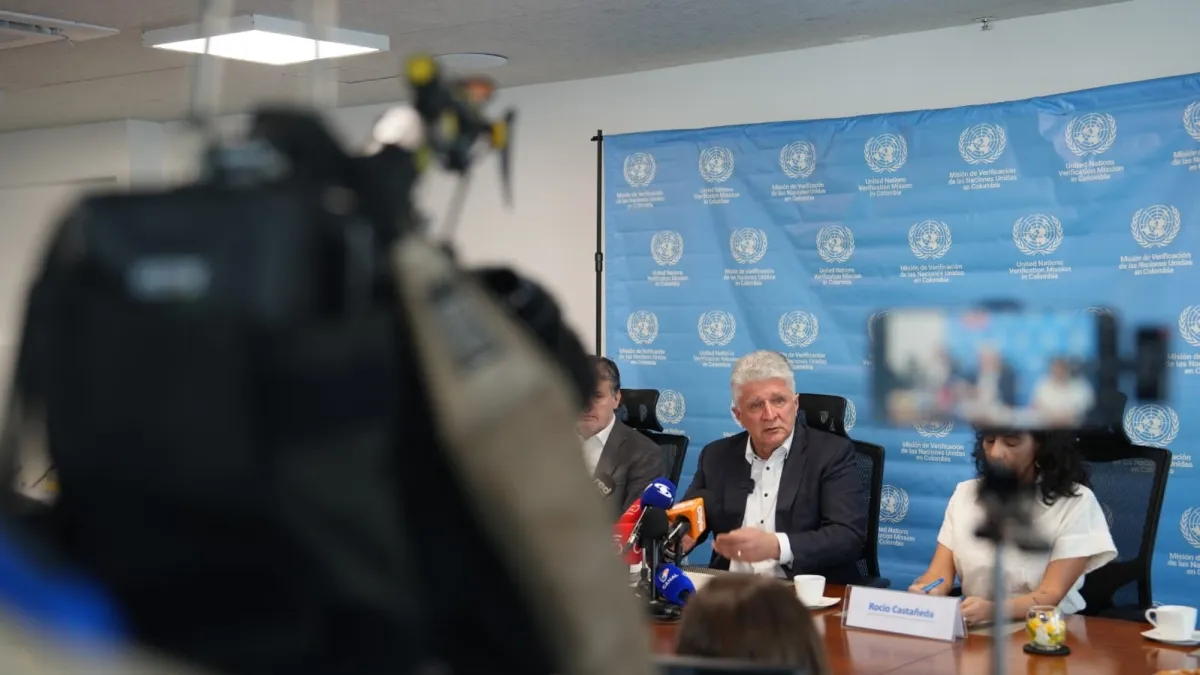
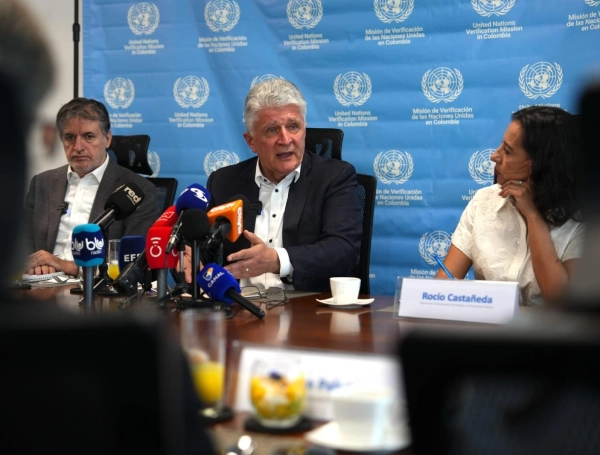
During his inaugural press conference at the Mission’s headquarters in Bogotá on Friday, November 6, 2026, the Special Representative of the Secretary-General and Head of the Mission, Miroslav Jenča, detailed the narrowed scope of the international body. Moving forward, the Mission will concentrate its resources and efforts strictly on two core pillars:
The social, political, economic, and community reincorporation of former combatants.
Comprehensive security guarantees for peace signatories, vulnerable communities, and social organizations operating in conflict-ridden territories.
Despite the exclusion of the land reform component and the persistent skepticism voiced by the executive branch, Jenča emphasized that the UN continues to view the initial implementation milestones of the peace accord as an international success story. Simultaneously, the Mission faces rigorous administrative hurdles, including looming budgetary pressures and the challenge of maintaining its vital territorial footprint through 29 local offices and over 10 mobile teams across 10 departments, even as it navigates a complex political dialogue with a newly restructured government cabinet in the Casa de Nariño.
Chronology of Events
The evolution of the UN Verification Mission’s mandate and its relationship with the Colombian state has been marked by a series of successive policy shifts, institutional adjustments, and political reorientations:
November 2016: The final peace accord is signed between the Colombian government and the FARC-EP, paving the way for the historic disarmament, demobilization, and reintegration process monitored by initial UN mechanisms.
Late 2024 to Late 2025: Facing previous political shifts and successive mandate adjustments—including the prior year’s elimination of tasks related to monitoring the sanctions handed down by the Special Jurisdiction for Peace (JEP) and the Ethnic Chapter—the Mission was forced into a major operational restructuring. This earlier phase triggered a steep 17 percent budget cut (roughly $15 million) and a reduction of more than 23 percent of its personnel.
August 7, 2026: President Abelardo De La Espriella assumes office, signaling a definitive shift in executive policy regarding the 2016 peace framework. The new administration adopts a heavily critical posture toward the accord, arguing through its diplomatic channels that the model promotes systemic impunity and undermines the principle of non-repetition.
September 20, 2026: Strategic leadership changes take shape within the Casa de Nariño. Chancellor Omar Bula and Colombian Ambassador to the UN Mauricio Gaona lead an international offensive to reevaluate peace architecture programs, while former minister Viviane Morales is later appointed as the High Commissioner for Peace and Director of the Implementation Unit. Simultaneously, lawyer Paola Andrea Onzaga takes the helm at the Agency for Reincorporation and Normalization (ARN).
Late October 2026: Head of Mission Miroslav Jenča travels to regional hotspots—such as Honda, Tolima—to meet with excombatants who have suffered displacement due to intense localized warfare between the ELN and the 33rd Front dissident faction in the Catatumbo region.
November 6, 2026: Miroslav Jenča holds his first major press conference in Bogotá following the Security Council’s one-year mandate renewal. He outlines the exclusion of rural reform, addresses relations with the De La Espriella administration, and presents the latest quarterly casualty figures affecting peace signatories.
Supporting Data and Territorial Footprint
The operational reality of the UN Verification Mission remains deeply anchored in Colombia’s most volatile regions. To counter potential bureaucratic shrinkage, the Mission is fiercely advocating before the UN budgetary committee to avoid another devastating fiscal contraction. The primary objective is to preserve the entirety of its localized infrastructure: 29 active offices spread across 10 strategic departments, alongside more than 10 mobile teams.
These facilities serve as lifelines in municipalities historically battered by cyclical violence, including:
Tibú and Ocaña (Norte de Santander / Catatumbo region)
San Vicente del Caguán (Caquetá)
Buenaventura (Valle del Cauca)
Mesetas (Meta)
Security Crisis Among Signatories
Statistical indicators compiled in the Mission’s latest quarterly reports underscore a profound humanitarian crisis confronting those who laid down their weapons:
501+ documented assassinations of former combatants since the signing of the accord.
12 of these victims are women.
66 belong to Indigenous communities.
59 are Afro-colombians.
185 documented attempted homicides against signatories.
56 forced disappearances.
Reincorporation and Institutional Budgets
The institutional apparatus tasked with civilian transition is likewise facing severe strain. The Agency for Reincorporation and Normalization (ARN)—under the newly appointed leadership of Paola Andrea Onzaga—has experienced a near-total operational paralysis since August 7, compounded by projections of a 37 percent budget cut for the upcoming fiscal year (2027). The ARN is currently mandated to attend to roughly 16,000 individuals, categorized as follows:
1,000 members of the Public Force appearing before the JEP.
4,000 demobilized individuals from various other defunct or legacy armed groups.
Official Responses and Perspectives
The friction between the international community’s assessment of the peace process and the domestic agenda of the Colombian government has created a complex diplomatic dynamic.
The UN Perspective
Miroslav Jenča defended the historical integrity of the 2016 agreement during his address to the press, drawing a sharp distinction between the successful initial phase of disarmament and the ongoing challenges of reintegration.
"If we look at this in terms of the peace agreement signed between two high contracting parties—the Government and the representatives of the FARC—yes, it has been a success," Jenča stated. "The laying down of arms, the monitoring of the ceasefire, the withdrawal of FARC-EP members from territories under their control was accomplished practically within a year. This truly was and is a success."
Regarding the excision of rural reform from the UN’s mandate, Jenča was pragmatic. While acknowledging that land redistribution will no longer be under direct international scrutiny, he stressed that it remains an inescapable legal obligation for the Colombian state:
"The comprehensive rural reform ceases to be the object of our verification, but it continues to be an essential point of the Final Agreement, the implementation of which constitutes a commitment of the Colombian State."
The Colombian Government Perspective
The administration of President Abelardo De La Espriella holds a diametrically opposed view. Through Colombia’s Ambassador to the United Nations, Mauricio Gaona, the executive branch has formally maintained that the 2016 accord cannot be held up as a global paradigm for peacebuilding. The government’s core critique centers on the assertion that the agreement institutionalized systemic impunity and failed to adequately safeguard the principle of non-repetition.
Despite these sharp ideological divisions, Jenča adopted a conciliatory diplomatic tone, noting that he respects the executive’s sovereign right to express its positions at the UN Security Council and affirming that ongoing, pragmatic dialogue remains open with Colombian authorities.
Implications
The structural changes forced upon the UN Verification Mission carry profound political, social, and institutional consequences for Colombia’s fragile peace architecture:
Weakened State Accountability on Land Reform: By removing the UN’s oversight mechanism from the Comprehensive Rural Reform, a vital external pressure point on the Colombian government has been eliminated. Land restitution and formalization—widely recognized as root causes of the armed conflict—now rely entirely on domestic political will, raising concerns among rural communities and civil society organizations.
Concentration on Immediate Physical Survival: With resources constrained and mandates narrowed, the Mission’s operations will hyper-focus on basic physical security and socio-economic reincorporation. While necessary given the staggering death toll among excombatants (surpassing 501 killed), this narrows the holistic approach originally envisioned for transitional justice and regional development.
A Shift in Domestic Interlocutors: The consolidation of peace policy under High Commissioner Viviane Morales and ARN Director Paola Andrea Onzaga signals a "surgical" internal review of peace programs by the Casa de Nariño. How these officials choose to restructure reintegration pipelines amid a 37 percent budget reduction will dictate whether thousands of signatories are successfully integrated into the formal economy or pushed toward recidivism.
Polarization vs. Institutional Resilience: As deep political polarization characterizes the De La Espriella administration’s stance on international oversight, the UN Mission must walk a narrow tightrope. Maintaining strict institutional impartiality while advocating for the protection of vulnerable signatories will test the diplomatic agility of the international body as it navigates its newly redefined operational landscape through 2027.
Main Facts: An Urgent Government Response to High-Level Allegations BOGOTÁ — In a swift and decisive executive action, the Colombian government has activated a comprehensive, high-priority security protocol to safeguard the life, physical integrity, and…
By Juan Pablo Penagos Ramírez Political Desk Updated: September 11, 2026 Main Facts Pestered by years of public bitter rivalries, accusations of corruption, ideological clashes, and a history of mutual betrayal, former Colombian President Gustavo…
By Camila Sanchez Fajardo Digital Outreach Desk, El Tiempo Updated: September 27, 2026 – 11:25 PM Main Facts In a sweeping and uncompromising national address delivered on Sunday, September 27, 2026, Colombian President Abelardo De…