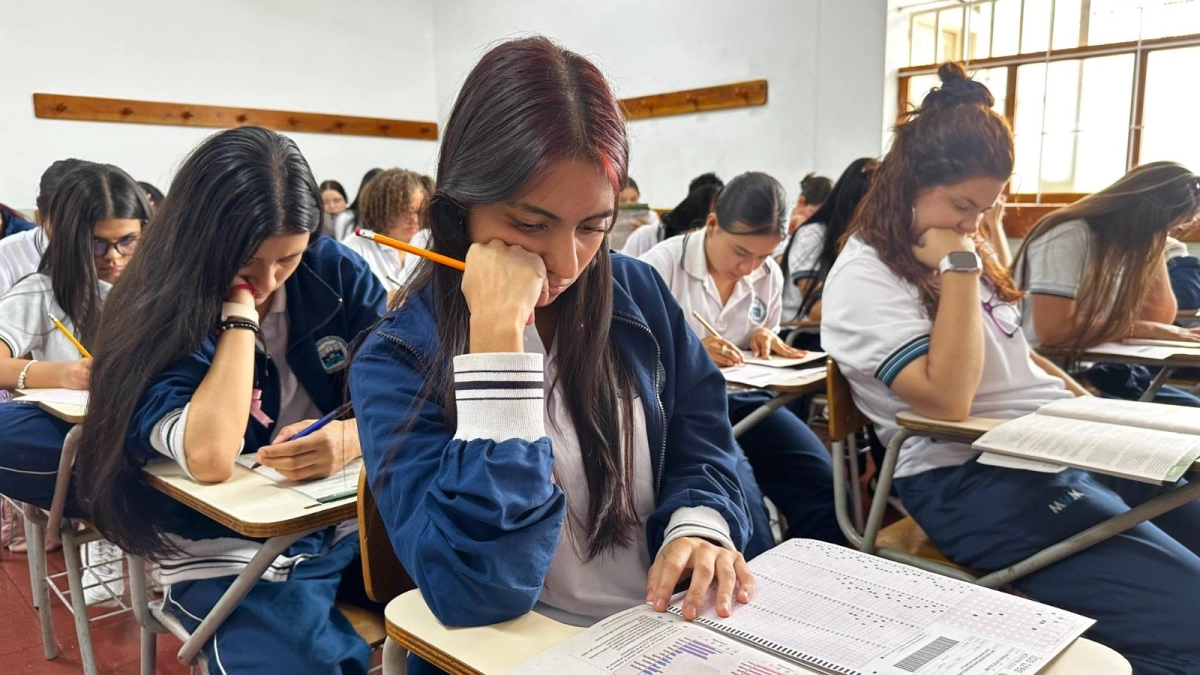
BOGOTÁ — The latest diagnostic indicators of Colombia’s educational landscape have sounded an alarm among academic analysts, policymakers, and educators. Official results from the 2026 Saber 11 examinations—the standardized national tests administered to high school graduates—reveal a synchronized decline across both academic calendars.
After several years of steady, post-pandemic recovery, the national performance trajectory has suffered an unexpected reversal. Both Calendario A (which concludes the academic year in November/December) and Calendario B (which finishes mid-year) registered a three-point drop in their global scores compared to the previous year. This regression places the country’s educational indices further away from historical benchmarks, underscoring the deep-seated structural vulnerabilities that continue to plague Colombia’s secondary education system.
Main Facts: A Synchronized National Decline
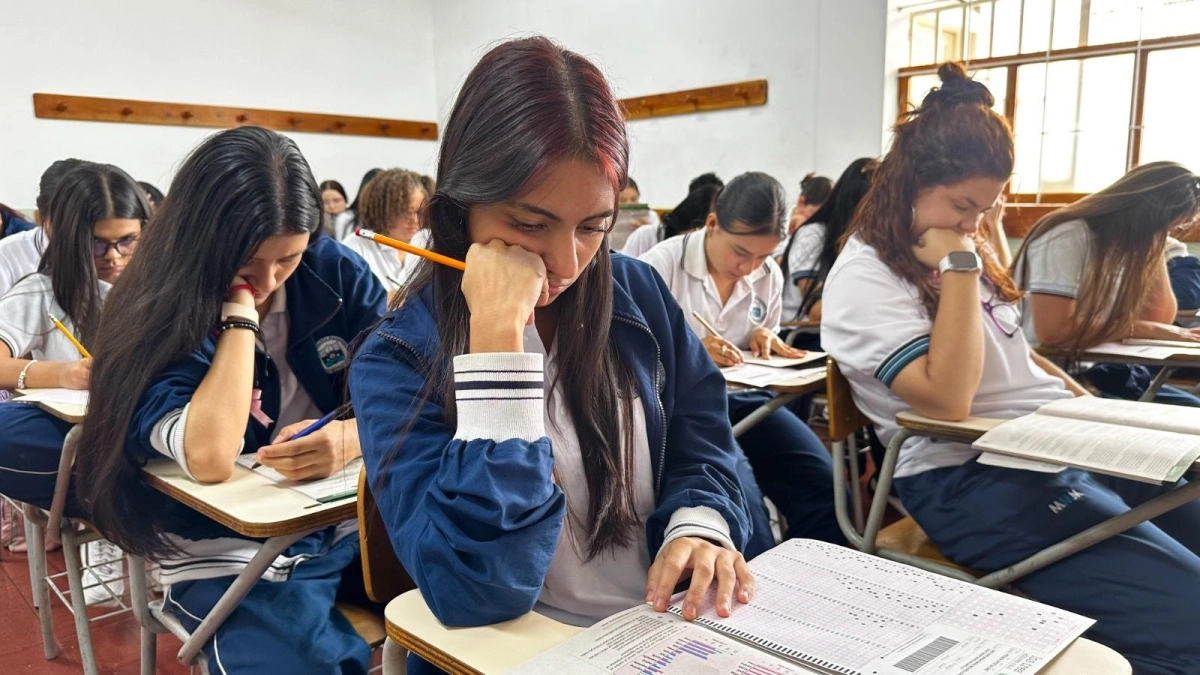
The primary takeaway from the 2026 Saber 11 evaluation is the widespread nature of the performance drop, which affected both school systems regardless of their operational schedules.
- Calendario A Performance: The global score dropped from 261 to 258 out of a possible 500 points. This breaks a multi-year upward trend that began following the unprecedented disruptions of the COVID-19 pandemic.
- Calendario B Performance: Similarly, the global score fell from 320 to 317 out of 500 points.
- Historical Benchmarks: Neither calendar managed to close the gap with the historic highs recorded in 2016. Calendario A sits six points below its peak of 264, while Calendario B rests nine points shy of its record 326 points from the same year.
Rather than stemming from a catastrophic collapse in a single discipline, the national slide is driven by fractional, one- to two-point regressions distributed across multiple core competencies. This widespread cooling of academic performance suggests systemic friction rather than localized failures.

Chronology and Historical Context: The Road from 2016 to 2026
To fully comprehend the gravity of the 2026 results, education experts emphasize the importance of viewing the data through a longitudinal lens.
1. The 2016 High and the Pandemic Abyss
The baseline for modern comparison remains 2016, a high-water mark for the Saber 11 evaluations in Colombia. Following that year, however, national scores entered a prolonged descent that was severely exacerbated by the global health crisis. By 2021, at the height of pandemic-related school closures and remote learning challenges, Calendario A bottomed out at a meager 250 points—a loss of 14 points over a five-year span. Analysts note, however, that the downward slope had quietly initiated even before the virus forced classrooms doors shut.

2. The Post-Pandemic Upward Path
Recovery was slow, deliberate, and hard-fought. Beginning in 2023, the system displayed encouraging signs of resilience:
- 2023: 257 points
- 2024: 259 points
- 2025: 261 points (marking the peak of the post-pandemic recovery phase)
These consecutive years of incremental gains fostered a collective optimism that the educational ecosystem was not only recovering lost ground but structurally solidifying its foundations. The 2026 drop to 258 points shatters that narrative, placing performance even lower than the 259 points reported in 2024. Despite this setback, the system retains an eight-point cushion above the 2021 pandemic floor, proving that not all hard-won progress has been erased.
Supporting Data: Competency Breakdown
An analysis of individual evaluation areas reveals stark contrasts in how different subjects weathered the 2026 testing cycle. The Saber 11 framework evaluates five core competencies: Critical Reading, Mathematics, Natural Sciences, Social and Civic Studies, and English.
Calendario A Breakdown
- Critical Reading: Suffered the most notable regression, dropping from 55 to 53 points (out of 100). Despite this drop, it remains one of the stronger subject averages alongside English.
- Mathematics: Slipped by a single point, moving from 53 to 52 points.
- Natural Sciences: Remained stagnant at 51 points.
- English: Held firm at 53 points, showing commendable stability.
- Social and Civic Studies: The lone bright spot in Calendario A, ticking upward from 49 to 50 points. Nevertheless, it persists as the lowest-scoring competency across the board.
Calendario B Breakdown
- Critical Reading: Remained stable at 64 points.
- Natural Sciences: Held steady at 62 points.
- Mathematics: Dropped from 65 to 64 points.
- Social and Civic Studies: Fell from 61 to 60 points, mirroring its status as the lowest-performing area in this calendar as well.
The English Exception
English continues to command a distinct category of its own. While it maintained 53 points in Calendario A, it soared to 74 points in Calendario B, keeping its position as the highest-performing competency overall—surpassing Critical Reading and Mathematics by a margin of ten points. Crucially, English was the only major area that did not surrender ground in either academic calendar.
Official Responses and Expert Analysis
The downward tick in performance has triggered prompt reactions from educational researchers and public policy experts, who caution against quick fixes or superficial interpretations of the data.
Luisa Vergara, a master’s degree holder in educational policy, emphasized the immense difficulty of reversing downward trends in standardized testing. "Recovering lost ground is exceptionally difficult because it demands an enormous, synchronized effort from the entire educational system," Vergara noted.

Furthermore, Vergara underscored that high-stakes tests taken in the final year of secondary school (Grade 11) are fundamentally lagging indicators. Learning deficits cannot be successfully repaired in the final semesters of high school. "By the time students reach the eleventh grade, learning lags are already deeply and structurally accumulated," she explained, pointing out that interventions must target early childhood and primary education to yield sustainable long-term results.
Deconstructing the Proficiency Levels
Experts urge looking beyond simple numerical averages to examine the Icfes proficiency levels, which categorize student capability from Level 1 (insufficient) to Level 4 (advanced).

Historical data preceding the 2026 results contextualize the ongoing crisis:
- In Critical Reading, 38 percent of students historically languish in levels 1 and 2.
- In Mathematics, that baseline vulnerability affects 33 percent of test-takers.
- In Natural Sciences, an alarming 65 percent of students cluster in the lowest proficiency tiers.
- In Social and Civic Studies, up to 70 percent of students fail to reach a satisfactory level, meaning only 3 out of every 10 graduates demonstrate adequate competency.
- Even in English—the country’s star performer—67 percent of students remain trapped in basic classifications (A- and A1).
These proficiency breakdowns illuminate why a modest one-point gain in Social and Civic Studies, while welcome, represents little more than a drop in the ocean against the broader backdrop of national educational deficiency.

Implications for Colombia’s Future
The 2026 Saber 11 results serve as a sobering reality check for Colombia’s social and economic ambitions. Standardized test scores are not merely academic metrics; they are vital predictors of social mobility, higher education access, and future workforce competitiveness.
- Strained Higher Education Access: With global scores slipping, competitive university admissions—which heavily weigh Saber 11 results—will become even more fiercely contested, potentially widening equity gaps between high-income private institutions and underfunded public schools.
- The Urgency of Structural Reform: The illusion of a permanent post-pandemic recovery has evaporated. Policymakers face mounting pressure to move away from short-term pedagogical adjustments and pivot toward deep structural investments in teacher training, curriculum alignment, and foundational primary literacy and numeracy.
- The Risk of Stagnation: As the distance from the 2016 performance benchmark widens once more, Colombia risks entering a protracted plateau where educational quality hovers well below its economic potential.
As researchers await upcoming granular indicators and detailed institutional breakdowns for the remainder of 2026, the central consensus remains clear: restoring momentum to Colombia’s educational metrics will require a generational commitment, moving past temporary fixes to confront the deep structural roots of learning poverty.