
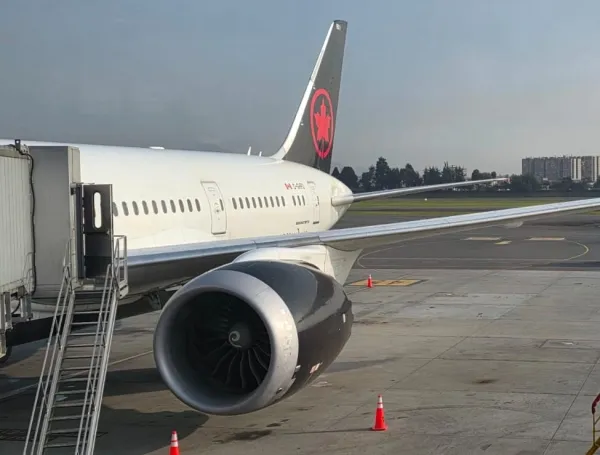
BOGOTÁ — In a strategic move designed to reinforce its footprint in South America, Air Canada has officially announced the deployment of its state-of-the-art Boeing 787-8 Dreamliner on its crucial routes connecting Bogotá with the major Canadian hubs of Toronto and Montreal.
This major upgrade is poised to transform the travel experience for thousands of business executives, tourists, and families who rely on these vital aerial corridors. By introducing a wide-body aircraft equipped with modern amenities and a robust 255-seat configuration distributed across three distinct service classes, the carrier is signaling a long-term commitment to the Colombian market and the broader Latin American aviation landscape.

Main Facts: Elevating the Standards of Transcontinental Travel
The core of Air Canada’s announcement centers on the deployment of the Boeing 787-8 Dreamliner to El Dorado International Airport in Bogotá, linking the Andean nation directly to Canada.
Key Aircraft Specifications:
- Aircraft Model: Boeing 787-8 Dreamliner.
- Total Capacity: 255 passenger seats.
- Cabin Configuration: Three distinct service tiers—Signature Class (business), Premium Economy, and Economy.
- Frequency: Eight weekly flights total, divided evenly between Toronto and Montreal (four frequencies per city).
The integration of the Dreamliner is not merely a capacity upgrade; it represents a qualitative leap in passenger comfort. Known for its advanced environmental controls—including lower cabin altitude pressure, higher humidity levels, and advanced dynamic LED lighting—the Dreamliner significantly reduces jet lag. Furthermore, the inclusion of three separate cabins allows travelers to tailor their journeys based on their individual budgets and preferences, ranging from the fully lie-flat seats in Signature Class to the extra legroom and upgraded dining options in Premium Economy.

Chronology: The Evolution of the Route and Rollout Schedule
The implementation of the Boeing 787-8 Dreamliner on the Colombian routes follows a meticulously planned rollout designed to optimize passenger flow and seamless connections. The active schedule began rolling out in late October 2026, establishing a predictable, high-frequency timetable for travelers.
- October 25, 2026: Launch of the Bogotá to Montreal route (Flight AC099), operating on a convenient schedule every Tuesday, Wednesday, Friday, and Sunday.
- October 26, 2026: Launch of the Bogotá to Toronto route (Flight AC095), operating every Monday, Tuesday, Thursday, and Saturday.
- Strategic Dual-Departure Days: Tuesdays stand out as a cornerstone of the new schedule, featuring simultaneous departures from Bogotá to both Toronto and Montreal. This dual-flight option provides unmatched flexibility for corporate travelers and vacationers alike.
This structural scheduling ensures that passengers departing from Bogotá can effortlessly tap into Air Canada’s extensive global network. Once arriving in Toronto or Montreal, travelers can easily connect to countless destinations across Canada, the United States, Europe, and Asia.

Supporting Data: The Strategic Importance of the Colombia-Canada Corridor
The decision to deploy a wide-body aircraft with a 255-seat capacity is backed by robust market analysis demonstrating steady growth in bilateral trade, tourism, and academic exchanges between Colombia and Canada.
Market Dynamics:
- Bilateral Trade: Canada and Colombia share a mature Free Trade Agreement (FTA), which has stimulated continuous corporate travel in sectors such as mining, energy, infrastructure, and technology.
- Tourism and Diaspora: Canada continues to be a desirable destination for Colombian students, tourists, and families visiting relatives, while Canadian travelers increasingly look to Colombia for ecotourism, cultural exploration, and business ventures.
- Global Connectivity Hubs: Toronto Pearson International Airport and Montreal-Trudeau International Airport serve as two of North America’s premier international gateways. By upgrading the aircraft on these routes, Air Canada is actively capturing high-yield connecting traffic that traditionally might have routed through US hubs.
The deployment of the Dreamliner directly addresses the rising demand for seat capacity, ensuring that peak-season bottlenecks are mitigated and that ticket availability remains competitive throughout the year.
Official Responses: Executive Perspectives on the Expansion
Air Canada’s leadership has underscored that the introduction of the Dreamliner to Bogotá is a testament to the country’s economic resilience and stability as an aviation market.
Rocky Lo, Air Canada’s Director of International Sales, emphasized the strategic importance of the South American nation in the airline’s global planning:

"Colombia is a strategic market for Air Canada. The incorporation of the Dreamliner on our routes from Bogotá reflects our confidence in the country and our long-term commitment to its international connectivity. We want to support the growth of tourism and business between both nations with a superior travel experience and access to our global network through Toronto and Montreal."
Industry analysts point out that Lo’s statements highlight a broader trend among major North American carriers: shifting larger, more fuel-efficient aircraft onto core Latin American routes to maximize profitability while meeting stringent environmental standards. The Dreamliner family, renowned for burning up to 25% less fuel and producing fewer emissions than older aircraft of similar size, aligns perfectly with Air Canada’s corporate sustainability goals.

Implications: What This Means for Passengers, Tourism, and Trade
The introduction of the Boeing 787-8 Dreamliner on the Bogotá-Toronto and Bogotá-Montreal corridors carries wide-ranging implications for multiple sectors of the economy and the everyday traveler.
1. Enhanced Passenger Experience and Comfort
For the individual traveler, the upgrade eliminates older narrow-body or less-optimized configurations, replacing them with a world-class wide-body experience. Features such as larger windows with electronic dimming, advanced cabin air filtration systems, and state-of-the-art personal touch-screen entertainment systems ensure that the nearly six-to-seven-hour journey between the Andean capital and Canadian hubs is exceptionally comfortable.

2. Boosting Bilateral Commerce and Business Travel
Corporate travelers will heavily benefit from the inclusion of the Signature Class. With fully flat-bed seats, priority airport services, and exclusive lounge access, business executives can arrive in Toronto, Montreal, or Bogotá rested and ready for critical meetings. The reliable eight-weekly-flight schedule also simplifies trip planning for companies managing cross-border operations.
3. Catalyzing Tourism and Cultural Exchange
By smoothing out the logistics of international travel, Air Canada’s expanded capacity is expected to drive further tourism in both directions. Canadian tourists seeking Colombia’s diverse landscapes—from the Caribbean coast to the coffee cultural landscape—now enjoy more robust and dependable airlift. Conversely, Colombian travelers gain smoother access to Canadian landmarks, festivals, and educational institutions.

4. Expanding Global Reach via North American Hubs
Beyond direct travel to Canada, the routes function as vital bridges to the rest of the world. Through the Toronto and Montreal hubs, passengers from Bogotá can seamlessly connect to major European capitals, vibrant Asian metropolises, and key business centers across the United States, all under a single airline network alliance.
As Air Canada moves forward with this enhanced schedule, the Bogotá-Toronto-Montreal corridor stands out as a prime example of how strategic airline investments can foster deeper economic, cultural, and personal ties between nations separated by thousands of miles but united by robust international connectivity.