Bogotá — The integration of artificial intelligence (AI) into daily operations, economic frameworks, and societal structures has rapidly shifted from a futuristic concept to an omnipresent reality. Surpassing even the most conservative predictions of a decade ago, the widespread adoption of AI tools is fundamentally transforming global economics, energy consumption, and human interaction. Amidst this worldwide technological wave, Colombia has emerged as a surprisingly strong contender, securing the position of the third-most active country in Latin America regarding the digital adoption and utilization of artificial intelligence technologies.
Data compiled from recent international studies illustrate a landscape defined by exponential financial investments, shifting geopolitical tech hubs, and a rapidly expanding user base in the Global South. While dominant superpowers continue to command the lion’s share of traffic and investment, developing markets like Colombia are carving out a significant footprint in the evolving digital economy.
Main Facts
The scale of the global artificial intelligence boom is underscored by unprecedented capital inflows and digital engagement. According to the AI Index Report 2024, published by the Institute for Human-Centered Artificial Intelligence (HAI) at Stanford University, global private investment dedicated specifically to generative artificial intelligence skyrocketed from approximately $3 billion to a staggering $25.2 billion in the span of just one year. This financial surge has fueled the creation, scaling, and deployment of thousands of AI-powered platforms worldwide.
However, the distribution of this technological adoption is far from uniform. According to metrics provided by AITools.xyz—a specialized platform that aggregates traffic estimates from SEMrush and Ahrefs across more than 9,500 AI tool websites globally—Colombia has achieved a notable milestone.
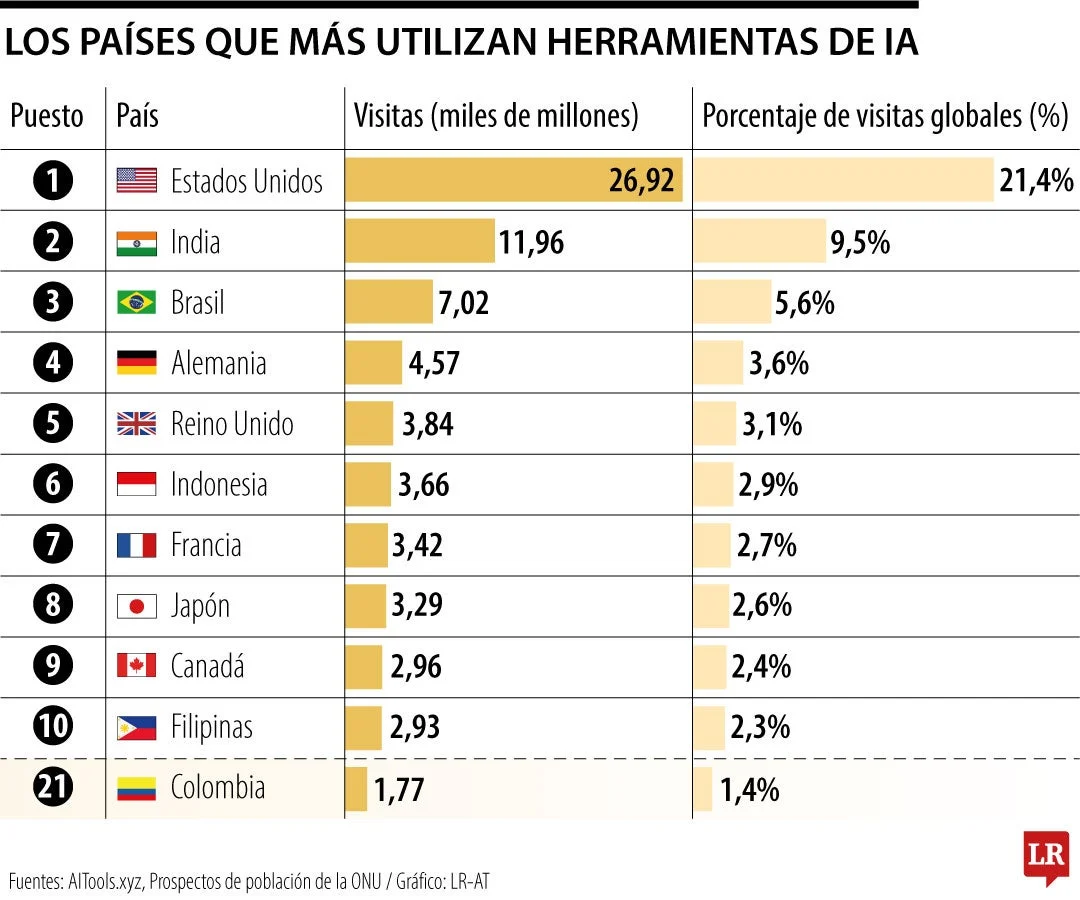
- Global Ranking: Colombia ranks 21st worldwide in terms of web traffic directed toward AI tools.
- Traffic Volume: The country accounts for slightly more than 1.7 billion visits to artificial intelligence platforms.
- Global Share: This volume represents 1.4% of the total global traffic analyzed in the study.
- Regional Standing: Within Latin America, Colombia stands firmly in the third position, trailing behind industrial powerhouse Brazil and runner-up Mexico.
Regionally, Mexico holds the 11th position globally, generating approximately 2.8 billion visits (2.2% of global traffic). Brazil claims an even higher standing within the top tier of the international index. Meanwhile, the global leaderboard is heavily skewed toward traditional tech giants: the United States leads the world with 26.900 billion visits (21.4% of the global total), followed by India with 12 billion visits and Brazil with 7 billion visits. Notably, these top three nations collectively generate 36.5% of all worldwide web traffic directed at AI tools, outperforming entire economic blocs such as Europe.
Chronology of the Global Artificial Intelligence Surge
To understand Colombia’s current standing in the Latin American technology ecosystem, it is essential to trace the rapid evolution of generative AI from a niche academic pursuit to a mass-market phenomenon.
- Pre-2022 (The Incubation Era): Artificial intelligence development was largely confined to corporate research and development labs, specialized academic institutions, and tech giants in Silicon Valley and China. Adoption was low, expensive, and limited to enterprises with dedicated data science teams.
- Late 2022 (The Generative Breakthrough): The public release of advanced generative models democratized access to artificial intelligence. For the first time, everyday users could interact with complex neural networks via simple, conversational web interfaces.
- 2023 (The Investment Explosion): As documented by Stanford’s AI Index Report, private capital flooded the sector. Venture capital and corporate funding shifted dramatically, lifting generative AI investment from $3 billion to over $25 billion globally in a 12-month window. This period saw the proliferation of thousands of specialized SaaS (Software as a Service) platforms dedicated to writing, graphic design, coding, and data analysis.
- 2024 (Global Diffusion and Measurement): Traffic aggregators such as AITools.xyz began mapping the decentralized footprint of AI adoption. During this period, emerging markets began showing distinct usage patterns. While North America and parts of Asia dominated raw volume, Latin American nations—led by Brazil, Mexico, and Colombia—registered massive spikes in web-based engagement with AI utilities.
- 2025–Present (Maturity and Strategic Integration): Usage has transitioned from novelty experimentation to functional integration within small-and-medium enterprises (SMEs), educational institutions, and freelance labor markets across Colombia.
Supporting Data and Methodological Nuances
While traffic rankings provide a valuable window into regional interest, industry analysts emphasize the importance of understanding the underlying metrics. The data provided by AITools.xyz relies on aggregate web traffic measurements rather than distinct individual user counts.
- Visits vs. Unique Users: The metric tracks total web sessions. This means a single professional or student in Bogotá or Medellín might visit multiple AI platforms multiple times a day, with each instance registered separately.
- Exclusion of Mobile Applications: A critical limitation of web-traffic-only metrics is the exclusion of mobile app sessions. In several major markets—most notably China, which currently ranks 15th on the list with 2.4 billion web visits—mobile ecosystems and dedicated applications are the primary mode of digital interaction. Consequently, countries where smartphone-first app usage dominates may see their actual AI adoption rates significantly underrepresented in web-only analyses.
- The Latin American Hierarchy: Within the region, Brazil establishes the benchmark for overall volume, driven by its massive population, robust domestic tech sector, and early Portuguese-language model adaptations. Mexico follows closely in the sub-regional rankings, benefiting from its deep economic ties to the United States and a burgeoning tech startup scene in Guadalajara and Mexico City. Colombia’s third-place ranking highlights its position as the leading tech hub in the Andean region, outperforming neighbors with active, digitally savvy urban populations in Bogotá, Medellín, Cali, and Barranquilla.
- The Global Giants: The stark contrast between the top-ranked nations and the rest of the world is stark. The United States alone generates more than double the traffic of second-place India. Furthermore, the combined output of the top three countries (U.S., India, Brazil) surpasses the entire European continent’s aggregate engagement with dedicated AI platforms, demonstrating a concentration of digital innovation power in select geographical corridors.
Official Responses and Expert Perspectives
The release of these global adoption figures has prompted reactions from technology analysts, business leaders, and policymakers across Latin America.
Industry experts in Colombia point out that the country’s high ranking—21st globally and third regionally—is a testament to the resilience and adaptability of its workforce. With a rapidly growing outsourcing sector, a vibrant ecosystem of digital agencies, and a young demographic eager to leverage productivity tools, Colombian professionals have aggressively integrated generative AI into copywriting, graphic design, software development, and customer service operations.
"The numbers reflect a grassroots adoption movement," notes a technology sector analyst based in Bogotá. "While corporate investment in enterprise-grade AI infrastructure still lags behind North America and Europe, the individual worker, the freelancer, and the local entrepreneur in Colombia are taking the initiative. They are utilizing accessible web tools to bridge resource gaps and compete on a global scale."
However, local academic voices have also issued notes of caution. Representatives from Colombian universities emphasize that high web traffic does not necessarily equate to deep technological sovereignty or domestic innovation. Much of the traffic directed toward AI tools represents consumption rather than creation. Analysts argue that for Colombia to move beyond being a passive consumer of foreign-developed technologies, national policymakers must increase investments in local STEM education, cloud infrastructure, and regulatory frameworks that encourage ethical AI development tailored to Latin American socioeconomic realities.
Implications for Colombia’s Economic and Social Future
The revelation that Colombia is the third-most active adopter of AI technology in Latin America carries profound implications for the nation’s economic trajectory, labor market, and educational systems.
1. Labor Market Evolution and Productivity
The heavy reliance on AI web tools by Colombian professionals suggests a workforce actively seeking productivity gains. In sectors such as business process outsourcing (BPO), software development, marketing, and creative arts, generative AI is redefining standard operating procedures. While this boosts individual output and allows local agencies to pitch for larger international contracts, it also raises legitimate concerns regarding job displacement and the need for large-scale reskilling initiatives.
2. Educational Transformation
Academic institutions in Colombia face mounting pressure to adapt curricula. With students already utilizing AI platforms extensively for research, writing, and problem-solving, traditional pedagogical models are being disrupted. Universities and secondary schools must transition from viewing AI as a tool for academic dishonesty to integrating artificial intelligence literacy as a core competency for the 21st-century workforce.
3. Digital Divide and Infrastructure Challenges
While urban centers like Bogotá and Medellín boast robust internet connectivity and vibrant tech communities, rural and marginalized regions of Colombia still experience significant connectivity gaps. As AI increasingly relies on high-speed internet and continuous cloud access, the existing digital divide threatens to concentrate the benefits of the artificial intelligence boom strictly within major metropolitan areas, leaving rural economies behind.
4. Policy and Regulation
As Colombia cements its status as a regional leader in AI adoption, the national government faces the challenge of establishing forward-looking regulatory frameworks. Policymakers must balance the need to protect consumer data, intellectual property, and labor rights with the imperative to foster innovation and avoid over-regulation that could stifle the organic technological adoption currently driving the country’s high global ranking.
Ultimately, Colombia’s position as the third-largest adopter of AI in Latin America demonstrates the country’s immense digital potential. Whether this consumer engagement will translate into long-term economic competitiveness and homegrown technological innovation remains one of the defining questions for the nation’s digital future.