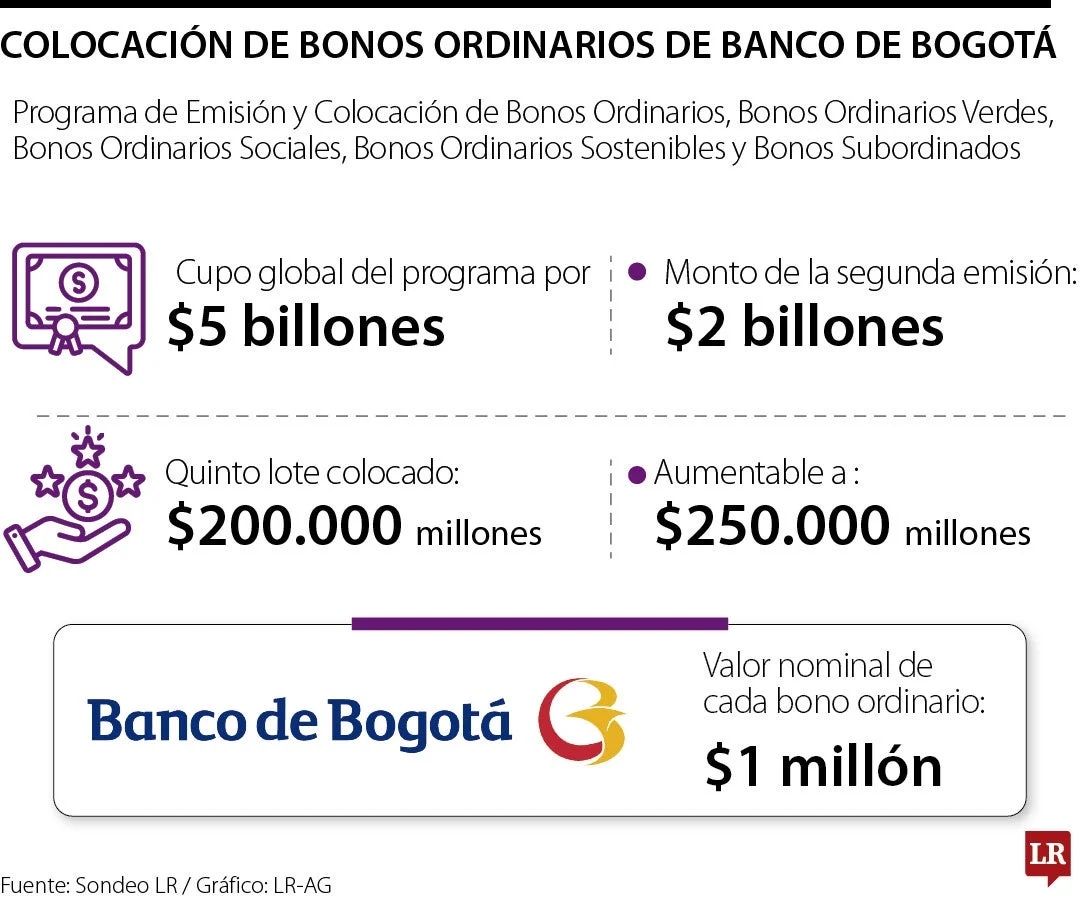
BOGOTÁ, COLOMBIA — In a strategic move to optimize its financial structure and secure robust liquidity for its ongoing operational and strategic expansion, Banco de Bogotá—one of the premier financial institutions in Colombia and a flagship subsidiary of Grupo Aval—has officially announced a massive new offering of ordinary bonds. The transaction, structured as the fifth tranche of the bank’s second major bond issuance program, aims to capture up to $250,000 million Colombian Pesos (COP).
This comprehensive financial maneuver highlights the sustained confidence that institutional and retail investors place in the Colombian banking sector, even amidst evolving macroeconomic headwinds. By leveraging diverse subseries tied to both inflation indices and fixed rates, Banco de Bogotá is presenting a sophisticated, flexible investment vehicle designed to meet the nuanced portfolio requirements of contemporary investors.
1. Main Facts of the Offering
The foundation of this financial operation rests on specific parameters designed to balance institutional liquidity needs with attractive, risk-adjusted returns for the market.
Core Financial Parameters
- Base Offering Size: $200,000 million COP.
- Over-allotment Option (Tranche to be activated upon excess demand): Up to an additional $50,000 million COP.
- Maximum Potential Placement: $250,000 million COP.
- Execution Date: Scheduled explicitly for November 26, 2026.
- Minimum Investment Threshold: $1 million COP per unit (matching the nominal value of each individual bond).
- Subscription Period: The public offering will remain active and open for trading during a single business day.
Structural Breakdown of the Tranches
To accommodate varying risk appetites and duration preferences, the offering has been meticulously structured into three distinct subseries:
- Subseries A (Inflation-Linked): Features a 36-month maturity term, index-linked directly to the Colombian Consumer Price Index (IPC). Interest payments are scheduled on a quarterly basis.
- Subseries B (Inflation-Linked): Features an extended 48-month maturity term, also indexed to the IPC, with quarterly interest payouts.
- Subseries C (Fixed-Rate): Features a shorter 24-month maturity term offering a fixed interest rate, providing predictable cash flows for conservative portfolios. Interest is similarly distributed on a quarterly basis.
Placement Mechanism and Intermediaries
The determination of final yields for each subseries will occur dynamically on the day of the placement, precisely prior to the official opening of the bidding process. The allocation of the securities will be executed via a Dutch auction mechanism, meticulously administered by the Bolsa de Valores de Colombia (BVC). This transparent mechanism ensures that titles are distributed based on competitive demand curves and pre-established market parameters.
The distribution syndicate is led by Aval Casa de Bolsa acting as the lead placement agent, working in strategic coordination with Valores Bancolombia as a co-placement agent, alongside direct placement channels managed internally by Banco de Bogotá.
2. Chronology and Program Evolution
To fully appreciate the scope of this fifth tranche, it is vital to examine the historical trajectory and structural evolution of Banco de Bogotá’s overarching debt issuance strategy. The current offering is not an isolated event; rather, it represents a calculated step within a multi-year capitalization and funding roadmap.
The Macro Program: A $5 Trillion Global Framework
The broader context of this issuance traces back to a massive, multi-tranche program approved by regulatory authorities, boasting an authorized global quota of $5 trillion COP. This program serves as Banco de Bogotá’s primary institutional pipeline for tapping domestic capital markets, managing asset-liability matching, and maintaining a healthy liquidity cushion.
- First Issuance Phase: In preceding years, the bank successfully utilized the initial tranches of its programmatic framework to secure long-term capital, optimize its funding costs, and finance its expanding credit portfolio across retail, commercial, and corporate segments.
- Transition to the Second Issuance: Following the exhaustion or maturation of the initial phases, the institution authorized a second issuance program with a total approved ceiling of $2 trillion COP.
- Prior Performance: Prior to the announcement of this specific fifth tranche, the bank had already successfully placed an aggregate of $1.10 trillion COP under this second issuance umbrella.
- Remaining Capacity: Accounting for prior placements, the residual balance available under the second issuance program stood at $899,068 million COP just before the announcement of this latest $250,000 million tranche. Following the full absorption of this upcoming November 2026 lot—assuming maximum over-allotment—the remaining available balance under the current authorized authorization will be reduced to approximately $649,068 million COP, clearing the path for future tranches down the road.
3. Supporting Data and Financial Metrics
A deeper dive into the quantitative data surrounding Banco de Bogotá and the Colombian fixed-income ecosystem provides essential context for evaluating the health and viability of this bond issuance.
Balance Sheet Resilience and Liquidity Management
Banco de Bogotá consistently maintains one of the most robust balance sheets in the Andean region. As a core pillar of Grupo Aval—Latin America’s diversified financial powerhouse—the bank benefits from diversified revenue streams, strong asset quality metrics, and rigorous capital adequacy ratios that consistently clear regulatory minimums set by the Superintendencia Financiera de Colombia.
- Capital Adequacy: The bank’s solvency ratios remain well above the mandatory thresholds, affording it the structural capacity to absorb economic shocks while continuing to extend credit to key sectors of the national economy.
- Asset-Liability Matching: By issuing both IPC-indexed bonds (36 and 48 months) and fixed-rate short-term instruments (24 months), Banco de Bogotá demonstrates advanced asset-liability management (ALM). Given that a significant portion of long-term commercial loans and mortgage portfolios in Colombia are inflation-indexed, matching these assets with long-term IPC-linked bonds significantly mitigates structural interest rate risk.
Market Dynamics and Investor Demand
The inclusion of an over-allotment option of up to $50,000 million COP reflects management’s confidence in robust domestic liquidity. Institutional investors in Colombia—notably pension fund administrators (Fondos de Pensiones y Cesantías or AFPs), insurance companies, and collective investment funds—constantly seek high-quality, investment-grade fixed-income instruments to match their long-term liabilities.
- The Inflation Hedging Angle: With historical volatility in consumer price indices, IPC-indexed bonds remain the gold standard for institutional investors seeking real capital preservation. The 36-month and 48-month subseries directly address this structural demand.
- Fixed-Income Appetite: Conversely, the 24-month fixed-rate tranche caters to tactical investors and corporate treasuries looking to lock in nominal yields ahead of anticipated shifts in monetary policy by the Central Bank of Colombia (Banco de la República).
4. Official Responses and Stakeholder Perspectives
While the formal documentation of the public offering outlines the mechanical framework of the transaction, executive commentary and market analyst reactions provide crucial qualitative insight into the strategic intent behind the move.
Executive Perspective
Although specific executive quotes regarding this exact fifth tranche emphasize standard regulatory compliance and procedural transparency, leadership at Banco de Bogotá has consistently framed debt capital market operations as a testament to institutional strength.
In past communications regarding similar programmatic offerings, senior executives have emphasized that the bank’s ability to regularly tap domestic debt markets at competitive rates underscores the market’s deep trust in its credit profile. By maintaining an active presence in the local bourse, Banco de Bogotá helps deepen the domestic capital market, providing a liquid benchmark yield curve that benefits other corporate issuers in Colombia.
Perspectives from Placement Agents and Market Makers
Representatives from Aval Casa de Bolsa and Valores Bancolombia have privately and publicly underscored the technical precision of the offering structure. By utilizing a Dutch auction mechanism managed by the BVC, the syndicate ensures absolute fairness and price discovery transparency.
Market analysts tracking the Colombian banking sector have noted that the timing of the announcement—targeting placement toward the end of November 2026—allows institutional portfolios to rebalance ahead of year-end liquidity cycles.
"The tiered approach—combining medium-term inflation protection with short-term fixed-rate options—is a textbook response to the current macroeconomic climate in Colombia. It offers institutional buyers precisely the hedging tools they require while giving Banco de Bogotá cost-effective funding flexibility," noted a senior fixed-income strategist based in Bogotá.
5. Implications for the Market and the Economy
The execution of a $250,000 million COP bond placement by a systemic institution like Banco de Bogotá carries wide-ranging implications for the broader Colombian economy, the local banking sector, and participating investors.
Deepening the Domestic Capital Market
Colombia’s financial system relies heavily on robust capital markets to bridge the gap between national savings and productive investment. By consistently utilizing its $5 trillion COP programmatic framework, Banco de Bogotá contributes directly to:
- Yield Curve Benchmarking: Providing continuous liquidity points along the 24-month, 36-month, and 48-month horizons helps establish reliable risk-free and corporate benchmark rates.
- Securitization and Alternative Funding: Reducing reliance purely on retail deposits by tapping institutional capital markets diversifies the bank’s funding base, enhancing overall financial stability.
Impact on Credit Expansion and Economic Activity
The capital raised through this bond issuance is not earmarked for idle reserves; rather, it feeds directly into Banco de Bogotá’s intermediation engine.
- Corporate and Retail Lending: The liquidity secured will support the expansion of credit lines for corporate enterprises driving infrastructure, manufacturing, and commerce, as well as retail consumer lending products.
- Counter-Cyclical Support: In periods of macroeconomic transition, having secure, pre-arranged access to institutional debt markets ensures that the bank can maintain steady lending flows without facing sudden liquidity crunches.
What This Means for Investors
For institutional funds, asset managers, and individual investors meeting the $1 million COP minimum threshold, the offering presents a balanced risk-return profile.
- For Conservative Savers: Subseries C provides a clear, fixed-rate yield over a manageable two-year horizon.
- For Long-Term Institutional Portfolios: Subseries A and B offer robust inflation-hedging capabilities, protecting purchasing power against inflationary pressures over a three- to four-year span.
- Transparent Allocation: The utilization of the BVC’s Dutch auction guarantees that allocation is governed by transparent market forces rather than arbitrary rationing.
Conclusion
Banco de Bogotá’s forthcoming fifth tranche placement of up to $250,000 million COP under its second bond issuance program stands as a landmark transaction for Colombia’s financial sector in late 2026. By masterfully combining flexible structural terms—ranging from inflation-linked securities to fixed-rate tenors—the institution reaffirms its market leadership, reinforces its balance sheet, and provides institutional investors with vital instruments for asset allocation. As the execution date of November 26, 2026, approaches, market participants are poised for strong demand, cementing Banco de Bogotá’s enduring reputation as a cornerstone of stability and growth in the Latin American financial landscape.