BOGOTÁ – As Colombia prepares for a pivotal transition of power, the nation finds itself at a profound energy and legislative crossroads. Just fifteen days before the inauguration of Abelardo de la Espriella, a leader who has signaled a robust intent to revitalize the hydrocarbon sector, the outgoing administration has made a final, defiant move: the filing of the seventh legislative attempt since 2018 to permanently ban hydraulic fracturing, or "fracking," within the national territory.
The incoming president inherits a landscape of frozen potential and immediate crisis. Two flagship pilot projects remain suspended since 2022, a growing gas deficit is already driving up utility bills for millions of citizens, and a fierce debate over the exploitation of Non-Conventional Reservoirs (NCR) remains unresolved in the halls of Congress. The stakes could not be higher; at risk is not only Colombia’s energy sovereignty but also its fiscal stability in an era of global volatility.
Main Facts: A Landscape of Suspended Ambition
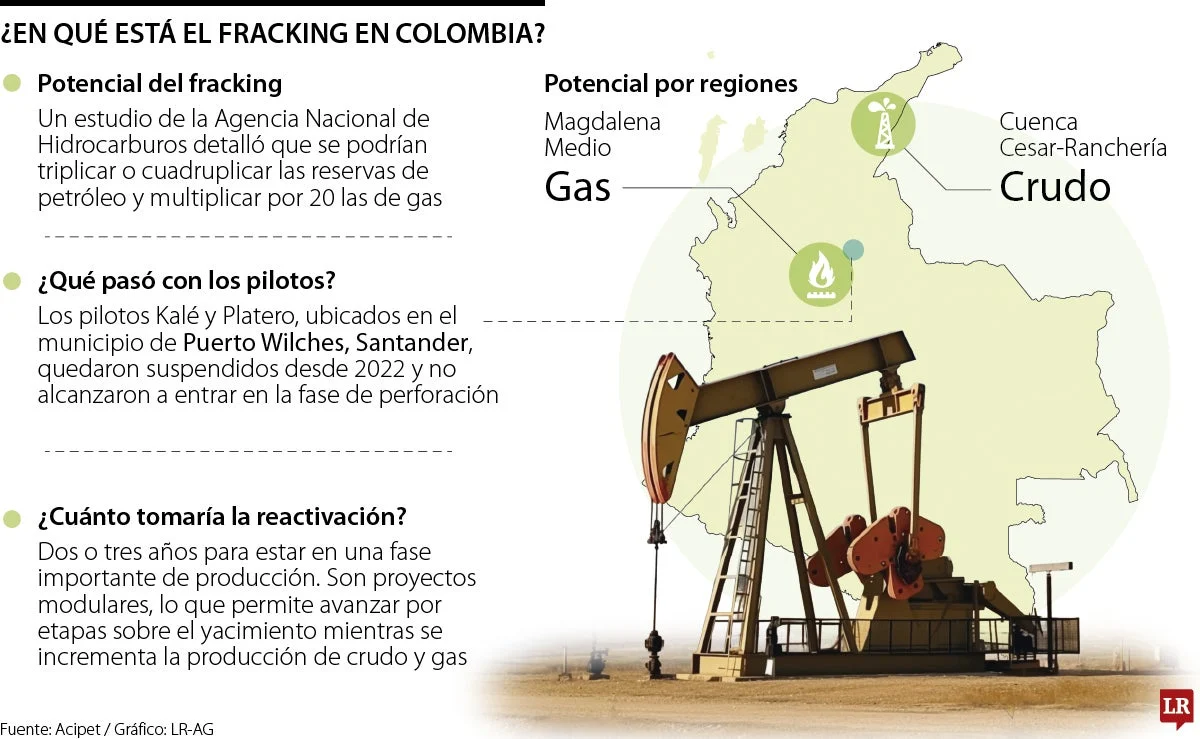
The technical reality of fracking in Colombia is currently one of "arrested development." Despite years of planning, the two primary Unconventional Pilot Research Projects (CEPI)—known as Kalé and Platero—have never moved beyond the drawing board into physical operation.
Located in the municipality of Puerto Wilches, Santander, these projects were designed to test the viability of the Magdalena Medio basin’s shale potential. According to Óscar Ferney Rincón Silva, director of the Colombian Association of Petroleum, Energy, and Related Technology Engineers (Acipet), the projects were halted in 2022 during their preliminary phase.
"We cannot speak of resuming drilling because drilling never actually began," Rincón Silva explained in a technical briefing. "The projects were caught in the administrative and preparatory activities of the first phase. Reactivation would not mean picking up a drill; it would mean restarting the complex process of moving from the preliminary stage to the execution stage."
The logistical hurdles are significant. After four years of suspension, the operational capacity that was once aligned for these projects has dissipated. Ecopetrol, the state-controlled oil giant, currently does not have these pilots in its active investment plan, and the specialized equipment and service contracts required for such high-tech operations are no longer in place.
Chronology: A Decade of Legislative Stalemate
The path to the current impasse has been marked by a repetitive cycle of legislative initiatives and administrative halts. The history of fracking in Colombia is a timeline of "what ifs":
- 2013: Argentina begins the development of Vaca Muerta, a similar shale formation. Colombia begins its own exploratory and regulatory preparation.
- 2018: The first formal bill to ban fracking is filed in Congress. It is eventually archived because it was never scheduled for debate in the Senate’s Fifth Commission.
- 2019: The National Hydrocarbons Agency (ANH) releases studies suggesting massive potential reserves in the Magdalena Medio and Cesar-Rancherías basins.
- 2020: A second attempt to ban the practice fails in the House of Representatives.
- 2022 (June): A third prohibition bill is archived.
- 2022 (August): The outgoing administration takes office with an anti-fracking mandate. The Kalé and Platero pilots are suspended.
- 2022-2024: Two more attempts to pass a ban (the fourth and fifth) gain some traction in debates but ultimately fail to cross the finish line due to lack of scheduling or procedural delays.
- June 2026: The sixth attempt is archived after failing to designate rapporteurs for the first debate.
- July 20, 2026: The outgoing government files the seventh bill to ban fracking, just weeks before Abelardo de la Espriella’s inauguration.
This chronological "loop" highlights a deep ideological divide in the Colombian state that has prevented a definitive decision on the country’s energy future for nearly a decade.
Supporting Data: The Magnitude of the Prize and the Price of Inaction
The technical arguments in favor of fracking are rooted in staggering numbers. According to the ANH, Colombia’s current oil reserves could be multiplied by three or four times if non-conventional reservoirs are tapped. For natural gas, the projections are even more dramatic: potential reserves could be up to 20 times the current levels.
The Magdalena Medio Potential
The Magdalena Medio region is the heart of this potential. Unlike the Cesar-Rancherías basin, which is gas-heavy, Magdalena Medio is predominantly rich in crude oil. However, its strategic value goes beyond the geology:
- Infrastructure: The region is home to the country’s largest gas pipeline, connecting the interior to the Caribbean coast.
- Refining: The nation’s primary refinery is located in the heart of the basin.
- Logistics: Over 100 years of traditional oil industry history have created a network of oil and multipurpose pipelines that could be adapted for the early phases of shale production.
The Argentina Parallel: Vaca Muerta
Acipet’s Rincón Silva draws a direct comparison to Argentina’s Vaca Muerta. Both regions feature source rocks with high hydrocarbon content. While Argentina faced an urgent fiscal and energy crisis in 2013, they chose to move forward. After three to four years of learning the reservoir, their production grew exponentially. Today, Argentina is not only self-sufficient in gas but has become a net exporter.
"Colombia could leverage that validated learning curve," says Rincón Silva. "If we start effectively now, we could reach relevant production levels for the national energy basket within two to three years."
The Cost of Importation
The alternative to domestic production is already hurting the Colombian economy. In May 2026, data from the Mercantile Exchange and the ANH revealed that 28% of the gas commercialized in the country was imported. This reliance on foreign gas is a direct driver of the rising utility tariffs currently being paid by households and industries, creating a regressive tax on the population and diminishing industrial competitiveness.
Official Responses: The Proposed Ban and the Industry’s Warning
The seventh bill filed by the "Pacto Histórico" coalition is a comprehensive attempt to shut the door on fracking permanently. The proposed law consists of six articles with specific targets:
- Total Prohibition: Article 1 bans the exploration and exploitation of hydrocarbons in bitumen sands, methane hydrates, coalbed methane, and shale.
- Technique Ban: Article 2 specifically outlaws "multistage hydraulic fracturing in horizontal sections."
- Contract Termination: The bill targets existing Research Project Contracts (CEPI). Article 4 establishes a transition regime where the ANH would offer contractors four choices: switching to conventional reservoirs, relocating investments, receiving new areas, or mutual contract termination without penalties for unexecuted investments.
- The Two-Year Deadline: If a contractor does not choose an option within two years, the contract is automatically terminated and liquidated.
The Industry Perspective
Acipet and other industry bodies argue that while the ban is debated, the country is ignoring "contingent resources"—discoveries that are already made but trapped behind administrative red tape. The ANH’s 2025 report identifies 10.5 trillion cubic feet (Tcf) in contingent gas resources. Of these, 2.6 Tcf are onshore, waiting for environmental licenses, social consultations, or infrastructure adjustments.
"The focus should be on streamlining these projects to mitigate the deficit," Rincón Silva suggests. While these resources might not fully cover the gap, they would significantly reduce the need for expensive imports.
Implications: A Race Against the Clock
As Abelardo de la Espriella prepares to take the oath of office, the implications of this "energy stalemate" are unfolding in real-time.
1. The Legislative Battle
The new President will face a Congress where the seventh prohibition bill is already sitting on the desk. His ability to build a majority to defeat this bill or to pass a counter-reform will determine whether Kalé and Platero ever see a drill bit. Unlike Argentina, where regulation is provincial, Colombia’s centralized regulation requires a high degree of national institutional coordination, making the political battle in Bogotá the primary hurdle.
2. Economic and Social Pressure
With 28% of gas already being imported, the De la Espriella administration will be under immediate pressure to lower energy costs. If the fracking pilots remain frozen, the government may have to look toward offshore projects like "Sirius" (formerly Uchuva-2), but these are years away from commercial production. The "gas gap" could become a significant political liability if inflation continues to be driven by utility prices.
3. Investment Climate
The "transition regime" proposed in the new bill—which essentially forces companies to abandon unconventional contracts—could send a chilling signal to international investors. Forcing a change in contract terms via legislation, even with options for relocation, raises questions about legal certainty in Colombia’s extractive sector.
4. Environmental vs. Fiscal Sovereignty
The debate remains framed as a zero-sum game between environmental protection and fiscal necessity. Proponents of the ban argue that Colombia’s water sources and biodiversity are too precious to risk. Proponents of the industry argue that without the 3x-4x increase in oil reserves and 20x increase in gas reserves that fracking offers, Colombia will lose its ability to fund its social programs and the very energy transition the outgoing government championed.
Conclusion
The inauguration of Abelardo de la Espriella marks the beginning of a new chapter in a long-running saga. The seventh attempt to ban fracking serves as a final "poison pill" from the outgoing administration, or a "final stand" for environmental protection, depending on one’s perspective.
For the technicians at Acipet and the workers in the Magdalena Medio, the issue is one of timing and logistics. "The knowledge is there, the infrastructure is there, and the need is certainly there," concludes Rincón Silva. Whether the political will can finally align with the geological potential remains the most consequential question for Colombia’s economy in the coming decade. The countdown to August 7th is not just a change of leaders; it is a countdown for the future of Colombian energy.