CARACAS & WASHINGTON — The dramatic return from exile of Venezuela’s foremost opposition leader, Nobel Peace Prize laureate María Corina Machado, has sent shockwaves through the nation’s political landscape, immediately laying bare a profound and escalating fracture within the country’s multi-billion-dollar petroleum sector.
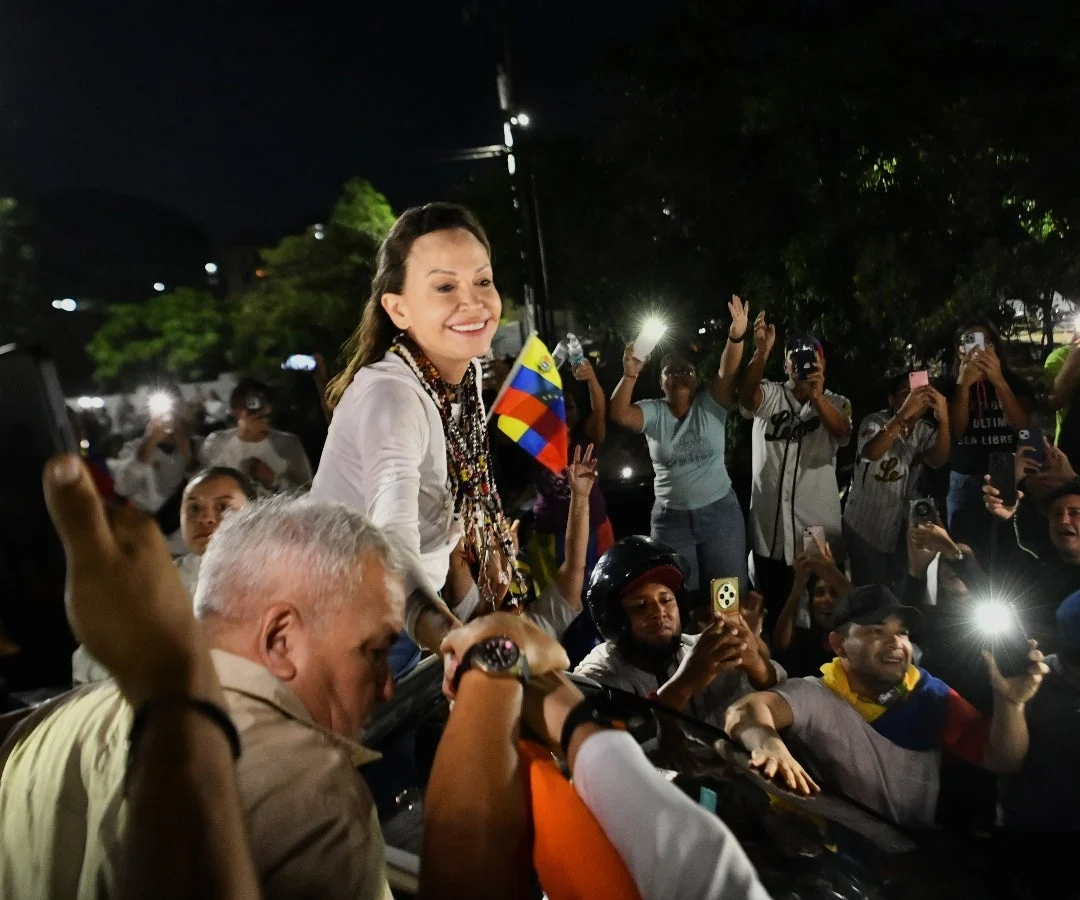
After weathering seven failed attempts to return to her homeland, Machado’s triumphant reappearance on Sunday drew colossal, emotionally charged crowds as she advanced toward Caracas. Her long-awaited return has instantly supercharged domestic pressure on the transitional apparatus to schedule free and fair elections, rebuild democratic institutions from the ground up, and restore the rule of law.
Yet, while millions of citizens celebrate a potential turning point toward freedom, industry insiders and geopolitical analysts warn that Machado’s resurgence has triggered a high-stakes standoff. On one side are major, publicly traded international energy conglomerates eyeing a return to the world’s largest proven crude reserves. On the other are lesser-known, politically connected entities that have scrambled in recent months to lock down lucrative extraction rights. As the nation balances on a precarious political tightrope, the future of Venezuelan petroleum has become a battleground of competing visions, casting a long shadow over the stability of future investments.
Main Facts
The core of the unfolding crisis centers on a stark dichotomy between traditional multinational energy giants and opportunistic, newly minted consortia.
- The Catalyst: María Corina Machado, Venezuela’s most popular political figure and a Nobel Peace Prize laureate, returned to the country on Sunday, sparking massive public demonstrations and accelerating demands for a democratic transition.
- The Industry Landscape: Despite holding the world’s largest crude reserves, Venezuela’s state-run oil infrastructure has been crippled by decades of systemic mismanagement, corruption, and sweeping nationalizations under the late President Hugo Chávez—which drove out giants like ExxonMobil and ConocoPhillips.
- The Post-Maduro Scramble: Following the capture of Nicolás Maduro in January, the interim government led by President Delcy Rodríguez—backed quietly by Washington—has rushed to sign sweeping agreements with new, often opaque investors to rapidly boost production.
- The Flashpoint: The most controversial of these recent developments is a 100-year concession awarded in August to North American Blue Energy Partners Inc. (Nabep), led by Venezuelan businessman Alejandro Betancourt, in which the United States government secured a direct 35% equity stake. Machado has vehemently denounced the deal, citing gross corruption, while Washington has defended its structural necessity.
Chronology: From Nationalization to the Present Standoff
To understand the fractures splitting Venezuela’s oil sector today, one must trace the historical arc that decimated its production capacity and paved the way for the current scramble for assets.
- The 2000s (The Chávez Era): President Hugo Chávez initiates a wave of aggressive nationalizations, systematically seizing the multi-billion-dollar assets of major international oil companies, including ExxonMobil Holdings Corp. and ConocoPhillips. Chevron Corp. remains the sole major U.S. operator to maintain a continuous, albeit restricted, presence in the country.
- January (The Turning Point): President Nicolás Maduro is captured amid mounting international pressure and internal collapse. An interim government, headed by Delcy Rodríguez, takes the reins and shifts economic strategy toward courting alternative foreign capital to revive the moribund economy.
- August (The Nabep Agreement): North American Blue Energy Partners Inc. (Nabep), spearheaded by Venezuelan entrepreneur Alejandro Betancourt, signs a landmark agreement securing a 100-year concession over 17 mature oil fields. Simultaneously, the United States finalizes an agreement to acquire a 35% stake in Nabep, ensuring direct access to its future output.
- Earlier This Month: Interim President Delcy Rodríguez announces ambitious projections, stating she expects nearly $76 billion in combined foreign investment in oil and natural gas over the next five years.
- The Following Monday: U.S. Secretary of State Marco Rubio publicly defends the structural integrity of the Nabep partnership, asserting that the joint venture provides vital commercial certainty. Meanwhile, María Corina Machado breaks her silence on the deal, labeling Betancourt’s past involvement as "obscene corruption."
- This Past Sunday: After seven failed attempts over years of forced exile, María Corina Machado successfully crosses back into Venezuela, greeted by roaring multitudes as she marches toward Caracas, instantly upending the calculus of foreign investors.
Supporting Data & Economic Projections
The viability of Venezuela’s oil sector depends entirely on capital injection, technological rehabilitation, and legislative predictability. According to leading energy economists, the numbers tell a story of immense potential tempered by severe structural risk.
- Reserves vs. Reality: Venezuela officially possesses the globe’s largest proven crude reserves—estimated at over 300 billion barrels. However, daily production plummeted from historical peaks near 3 million barrels per day (bpd) down to historic lows during the height of the Maduro regime.
- Short-Term Horizons: Francisco Monaldi, director of the Latin America Energy Program at Rice University’s Baker Institute, notes that current investment commitments are heavily concentrated in mature fields where capital recovery is rapid.
"Those investments could elevate Venezuelan oil production between 1.7 million and 1.8 million barrels daily in a span of two to three years," Monaldi explains.
- The Long-Term Hurdle: Pushing production back past the 3 million bpd threshold—matching historical output maximums—cannot be achieved through quick fixes. Monaldi stresses that such a milestone demands massive capital outlays into entirely new exploration blocks, underpinned by ironclad legal and institutional guarantees.
- The Investment Gap: Major publicly traded corporations remain hesitant. Darren Woods, CEO of ExxonMobil, stated in January that any prospective return by his company would require "significant changes" to the country’s legal and commercial architecture, specifically demanding durable protections against arbitrary expropriation.
Official Responses and Stakeholder Positions
As the political and economic futures of Venezuela collide, key players in Caracas, Washington, and academia have staked out definitive positions regarding the legitimacy of contracts and the path forward.
The Opposition and Reformists
María Corina Machado has outlined a radically different regulatory framework for a post-transition Venezuela. Her platform calls for the extensive privatization of the hydrocarbons sector, the re-establishment of fiercely competitive public bidding processes, and the creation of a fully independent energy regulatory agency.
Machado has maintained that while she will respect any preexisting, legitimate contracts, she views deals engineered under the interim Rodríguez administration—particularly the Nabep concession—as legally dubious. She explicitly targeted Alejandro Betancourt’s track record, criticizing his past business dealings in Venezuela’s beleaguered electrical sector and warning that figures linked to prior systemic corruption will find no welcome in a reformed economy.
The Interim Government & Washington
Interim President Delcy Rodríguez has championed aggressive economic pragmatism, arguing that immediate survival and rebuilding require onboarding any willing financial partner, regardless of pedigree.
In Washington, the stance reflects a calculated balancing act. Defending the U.S. acquisition of a 35% stake in Nabep, Secretary of State Marco Rubio argued on Monday that the partnership provides the operating entity with the vital financial insulation needed to mobilize private capital before the political transition formally concludes. Rubio insisted that Washington’s stake in energy security operates on a parallel track distinct from the broader diplomatic push for democratic elections.
Industry Analysts & Economists
Independent experts urge caution, warning that short-term expediency may sow the seeds of long-term instability.
- Francisco Rodríguez, a Venezuelan economist and academic at the University of Denver, points out the deep philosophical split within the investor community:
"The majority of oil sector investors, though not all, would probably prefer to see a full transition to democracy and a legitimately elected government that offers greater security over their property rights… However, there is an important group of actors with vested interests who do not see it that way."
- David Goldwyn, head of the Atlantic Council’s energy advisory group, notes that Machado is navigating a political minefield:
"Machado has a delicate line to walk between asserting her position within Venezuela and avoiding a rupture with the Trump administration. She seeks to reassure investors ensuring that property rights and legitimate contracts will be honored, while pushing for more transparent and competitive agreements and subjecting to scrutiny those she considers questionable."
Implications: Paralysis, Scrutiny, and the Long Road Ahead
The intersection of Machado’s political renaissance and the carving up of Venezuela’s oil fields carries profound implications for the domestic population, regional geopolitics, and global energy markets.
1. The Risk of Investor Paralysis
Economist Francisco Rodríguez has warned of an impending "policy paralysis" across the board. International capital markets hate uncertainty; as long as the timeline for legitimate elections remains fluid, and as long as the political standing of Machado relative to the transitional government remains unresolved, conservative boardrooms will hit the pause button on multi-billion-dollar greenfield commitments.
2. Heightened U.S. Congressional Scrutiny
The involvement of American entities in non-competitive or fast-tracked Venezuelan concessions is unlikely to escape domestic political friction. Energy expert David Goldwyn emphasizes that as the U.S. approaches mid-term elections, congressional oversight committees are almost certain to launch deep-dive investigations into agreements like the Nabep contract. This introduces an entirely external layer of regulatory and political risk for investors who thought they had secured Washington’s blessing.
3. The Test of Democratic Consolidation
Ultimately, the central tension in Venezuela is not merely about barrels pumped or dollars invested; it is about the structural integrity of the state. Francisco Monaldi underscores that even if companies manage to secure favorable terms under the current interim administration of Delcy Rodríguez, the foundation remains built on shifting sands:
"Even if you get a very favorable deal with Delcy Rodríguez’s government, long-term stability is not resolved… And that’s why you would want a resolution relatively soon."
Until free elections are held, democratic institutions are restored, and a transparent legal framework replaces backroom concessions, Venezuela’s oil wealth will remain both its ultimate salvation and its deepest curse—a fractured prize waiting for a nation made whole.