By Juan Pablo Penagos Ramírez (Adapted for international reporting)
Political Desk
Main Facts
A severe institutional crisis is unfolding within Colombia’s Ministry of Foreign Affairs (la Cancillería) following explosive revelations regarding alleged inconsistencies, falsifications, and academic inflation in the résumés of top-tier government officials. The latest scandal directly targets the Ministry’s General Secretary, Gina González Grau. According to oversight findings brought to light by prominent congressional members, González Grau allegedly certified five years of professional experience through a consulting firm that did not legally exist during a significant portion of the claimed timeframe.
The controversy erupted when lawmakers Ariel Ávila (Alianza Verde) and Daniel Monroy (Pacto Histórico) publicly exposed that González Grau ostensibly failed to meet the strict legal prerequisites mandated for the high-ranking diplomatic administrative post. Under the revised Functional Manual of the Ministry of Foreign Affairs—specifically modified by Resolution 0341 of 2026—aspiring candidates for the General Secretariat must possess an official professional degree in law or related fields, a master’s degree, and a minimum of 72 months (six years) of verified professional experience.
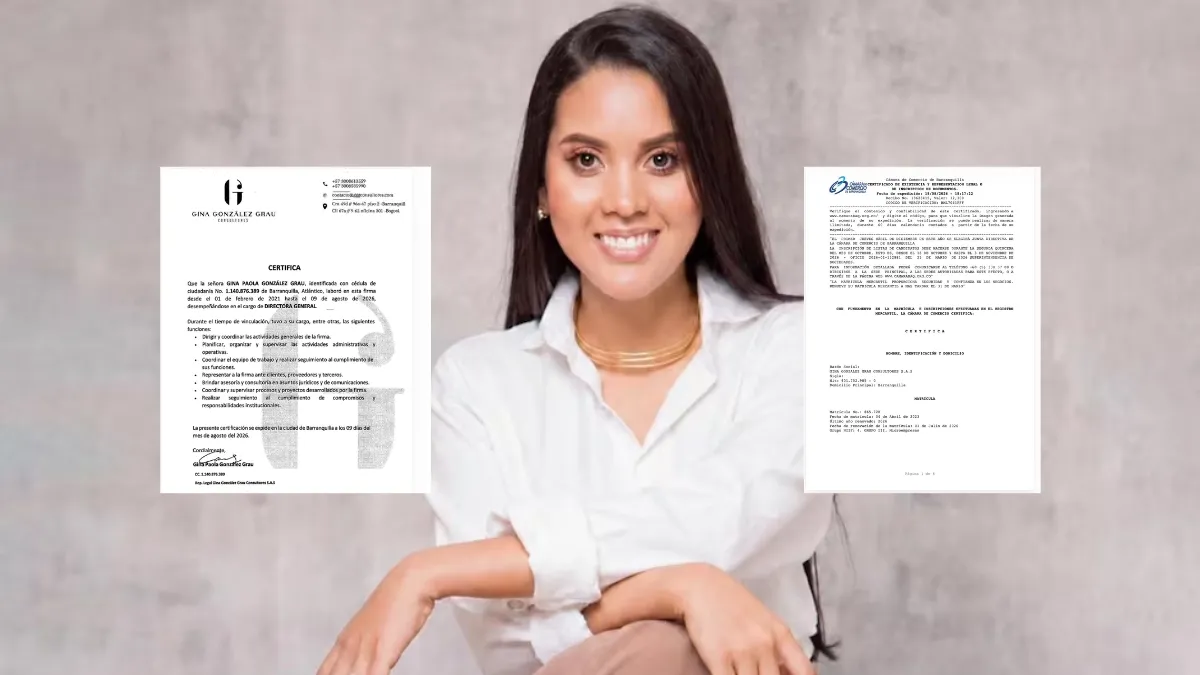
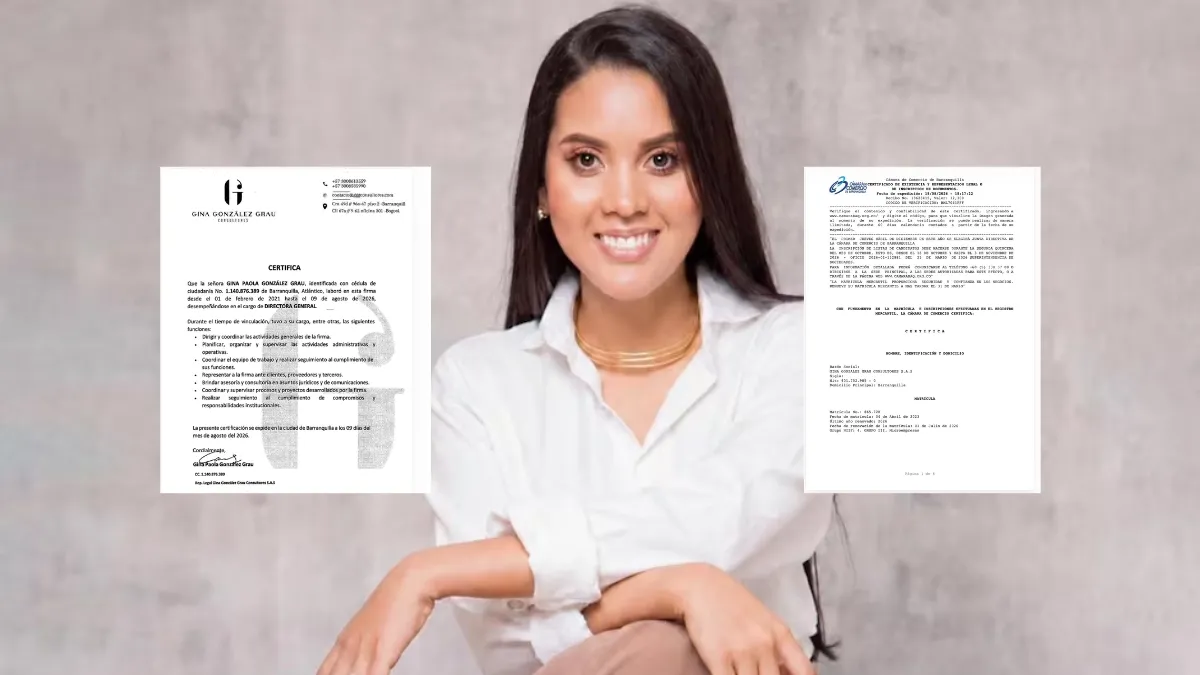
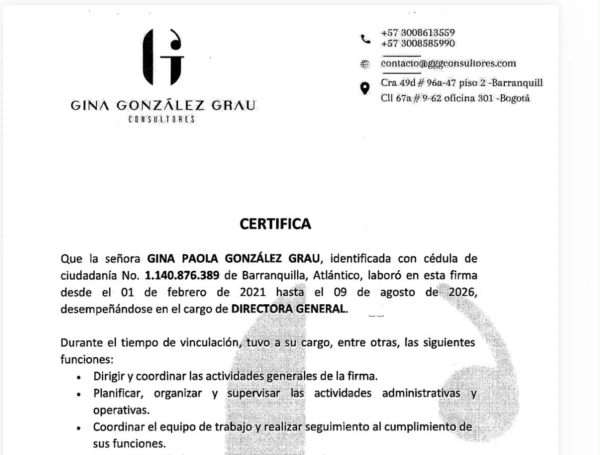
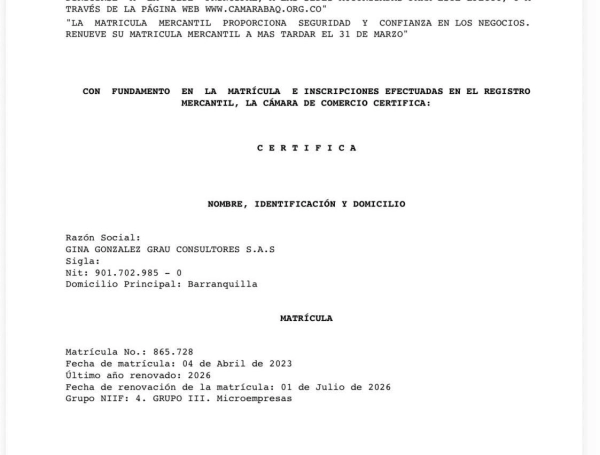
To fulfill this demanding criteria, González Grau presented a professional certification stating she served as the General Director of her own private enterprise, Gina González Grau Consultores, from February 1, 2021, through August 9, 2026. However, official records from the Chamber of Commerce of Barranquilla and the Single Business Registry (RUES) reveal a glaring discrepancy: the commercial establishment was not legally constituted via private document until January 2023, and its official commercial registration was only formalized in April 2023.
Consequently, approximately 26 months of the professional experience utilized by González Grau to secure her multi-million-peso public sector post correspond to a period when her consulting firm was entirely non-existent. In response to these findings, Representative Daniel Monroy formally filed a criminal complaint with the Office of the Attorney General (Fiscalía General de la Nación) for alleged falsification of a public document, alongside a formal disciplinary complaint submitted to the Inspector General’s Office (Procuraduría General de la Nación).
Chronology of Events
To fully understand how this administrative controversy unfolded within the heart of Colombian diplomacy, a chronological breakdown clarifies the timeline of the company’s creation, the appointments, and the subsequent whistleblowing:

- February 1, 2021: According to the disputed work experience certificate provided by Gina González Grau, this marks the official start date of her tenure as General Director at Gina González Grau Consultores.
- January 2023: Gina González Grau Consultores is formally constituted by private document, according to records from the Chamber of Commerce of Barranquilla. Prior to this date, no legal corporate entity under this name or registration existed in Colombia.
- April 2023: The company receives its official commercial registration (matrícula mercantil) in the Chamber of Commerce of Barranquilla, legally empowering it to operate.
- August 2026: Gina González Grau, an attorney graduated from the Universidad Libre with a specialization in Criminal Law, is officially appointed as the General Secretary of the Ministry of Foreign Affairs.
- August 22, 2026: Public scrutiny and internal friction regarding the transparency of high-level nominations within the Cancillería begin to gain traction in national media reports.
- October 26, 2026: Representatives Ariel Ávila and Daniel Monroy expose the document fraud publicly. They reveal that González Grau self-certified her employment history using an entity she owned as legal representative, utilizing 26 months of "phantom" experience. That same day, Rep. Monroy formally files criminal and disciplinary actions against her.
Supporting Data and Evidence
The weight of the accusations against the General Secretary relies heavily on verifiable public documents, corporate registries, and state-mandated job requirements.
The Regulatory Framework
The position of General Secretary within the Ministry of Foreign Affairs is a pillar of administrative governance, managing budgets, human resources, and internal logistics. Recognizing the sensitivity of the role, Resolution 0341 of 2026 tightened the prerequisites for applicants:
- Professional Undergraduate degree in Law or closely related disciplines.
- Postgraduate Education: Mandatory Master’s degree.
- Experience: Exactly 72 months (6 years) of certified professional experience.
The Self-Certification Anomaly
According to details exposed by Senator Ariel Ávila during legislative oversight debates, the core issue lies in the conflict of interest and chronological impossibility of the self-issued certificate:
"She certified herself with a company of her own, where the legal representative was her. What is the gravity of this? According to the Single Business Registry (RUES) and the Chamber of Commerce of Barranquilla, this corporation was constituted by a private document in January 2023 and registered in April 2023. That means the lady inserts work experience running between 2021 and 2026, but the company actually began operations in 2023."
Out of the five years (60 months) of experience purportedly earned at her own consultancy, roughly 26 months transpired before the business ever existed on paper. This mathematical and legal impossibility forms the cornerstone of the prosecution’s case regarding the falsification of credentials.
Official Responses and Political Repercussions
The scandal surrounding Gina González Grau does not stand in isolation. It compounds an existing wave of skepticism and investigation targeting the highest echelons of the Ministry of Foreign Affairs, notably enveloping Foreign Minister (Canciller) Omar Bula.
The Broader Cancillería Crisis
Weeks prior to the revelations concerning the General Secretary, investigative reports published by the independent outlet Casa Macondo unveiled severe discrepancies in the educational background of Foreign Minister Omar Bula. According to investigative findings, Bula allegedly presented a five-day basic certificate course taken at Harvard University as an advanced technical formation, alongside a specialized certification program from George Washington University packaged as a full postgraduate specialization.
The convergence of academic inflation at the ministerial level and alleged document falsification at the administrative level has drawn fierce rebukes from veteran diplomats and foreign policy experts.
Arlene Tickner, a prominent scholar and former Colombian ambassador, did not mince words when assessing the institutional decay within the Cancillería:

"To the invention of academic titles by the mister minister is now added the falsification of documents by the general secretary in the Ministry. Both infractions merit a rigorous investigation."
Institutional Silence vs. Legal Action
As of late October 2026, neither Gina González Grau nor Foreign Minister Omar Bula have issued comprehensive public refutations addressing the specific documentation timelines highlighted by Congress. Meanwhile, state control entities are moving forward:
- The Fiscalía General de la Nación is tasked with reviewing the validity of the work certification under criminal statutes regarding the fabrication and usage of falsified public documents.
- The Procuraduría General de la Nación is evaluating the disciplinary parameters to determine if González Grau violated the administrative code of conduct for public servants, which could lead to immediate suspension and barring from holding public office.
Implications for the Government and Public Administration
The ongoing controversy at the Ministry of Foreign Affairs triggers deep concerns regarding the vetting processes implemented by the current national administration. Key implications include:

- Erosion of Institutional Trust: The Ministry of Foreign Affairs represents Colombia on the global stage. Having top executives embroiled in scandals involving fabricated résumés and non-existent professional timelines tarnishes the country’s diplomatic credibility.
- Weaknesses in Human Resources Vetting: The ease with which an official can allegedly self-certify experience through a non-existent company points to systemic vulnerabilities in how background checks and credential verifications are performed before high-level executive appointments are formalized.
- Legal Precedents: If the judicial systems validate the complaints filed by Representatives Ávila and Monroy, this case could serve as a severe legal precedent penalizing public servants who attempt to bypass meritocratic and experience-based legal mandates through fraudulent self-endorsements.
As investigative proceedings advance in the coming weeks, the pressure on both General Secretary Gina González Grau and Foreign Minister Omar Bula continues to escalate, testing the administration’s commitment to transparency, accountability, and institutional integrity.