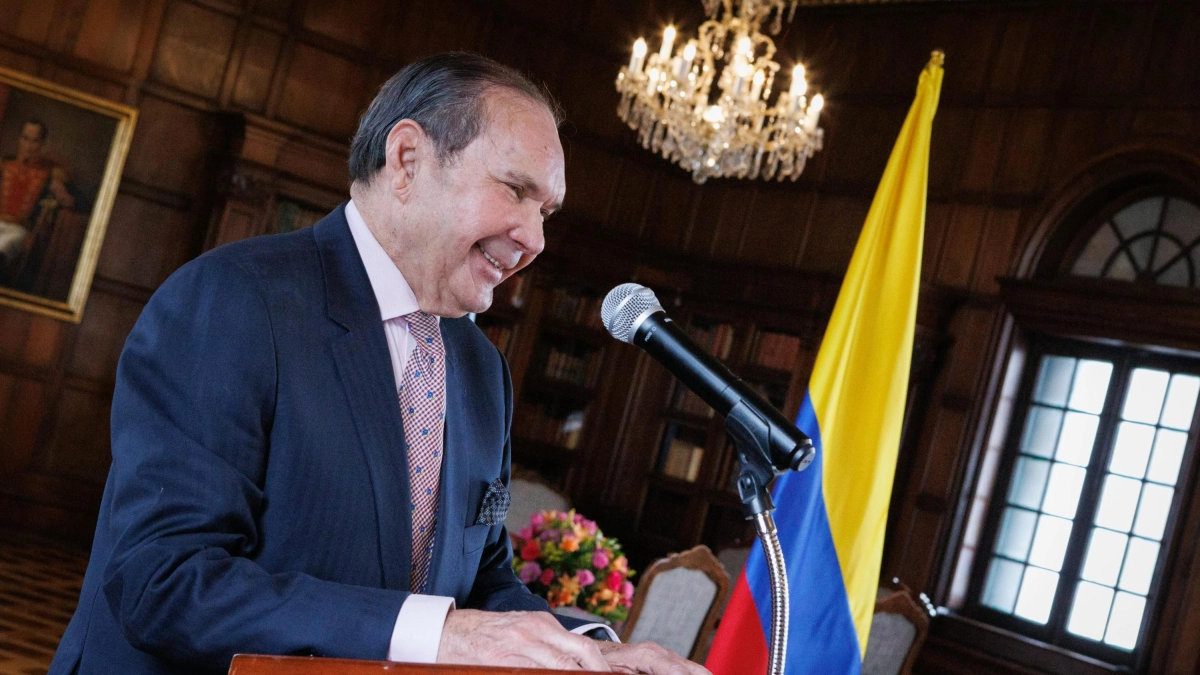
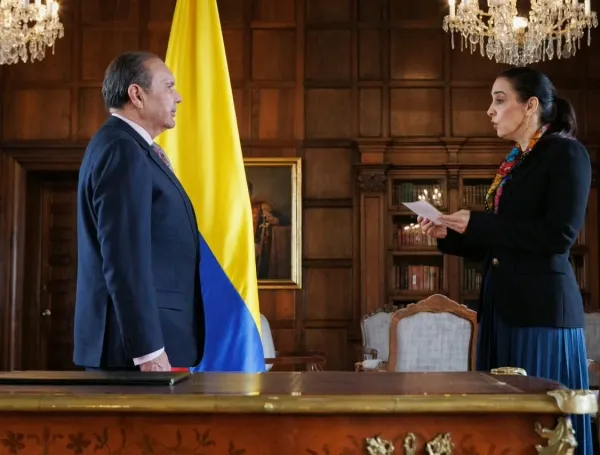
BOGOTÁ — In a significant shift toward meritocracy and institutional stabilization within Colombia’s foreign service, the government of President Abelardo De La Espriella has officially sworn in veteran economist Juvenal Infante as the nation’s new ambassador to the People’s Republic of China. The high-profile ceremony, led by Vice Chancellor Adela Maestre, took place at the historic Palacio de San Carlos in Bogotá, marking a pivotal moment in bilateral relations between the Andean nation and the Asian superpower.
The appointment of Infante, formalized under Decree 1616 of 2026, is not merely a routine diplomatic assignment; it is a nod to deep historical continuity. Infante is widely recognized as one of the key architects behind the establishment of official diplomatic ties between Bogotá and Beijing back in 1980. His return to active diplomatic service at the highest level signals the administration’s intent to pair seasoned institutional memory with strategic international execution.
Simultaneously, the administration has announced a sweeping internal convocatoria (call for applications) to fill crucial ambassadorial posts across five strategic global missions. By prioritizing career diplomats through a transparent, merit-based selection framework, the De La Espriella administration aims to pivot away from purely political appointments, addressing long-standing criticisms regarding the professionalization of Colombia’s foreign ministry.
Main Facts
The cornerstone of recent diplomatic developments is the formal assumption of office by Juvenal Infante as Ambassador to China, coupled with President De La Espriella’s sweeping overhaul of the criteria governing international missions.
The China Ambassadorship: Juvenal Infante, an economist born in Santa Marta, took the oath of office at the Palacio de San Carlos, administered by Vice Chancellor Adela Maestre. Infante brings a decades-long pedigree in international relations and public service to Beijing.
Merit-Based Convocatoria: President De La Espriella announced that five key embassies—Denmark, Egypt, the Philippines, Finland, and Vietnam—will be filled via an internal competitive process open exclusively to members of the career diplomatic service.
Pending Permanent Appointments: The executive branch is simultaneously advancing bureaucratic and legal procedures to officially appoint permanent, confirmed ambassadors to Germany and Canada.
Strict Timeline: The application window for the five contested missions opens on Friday, October 30, and closes sharply on Tuesday, November 3, 2026, followed by a rigorous multi-agency evaluation phase.
Chronology of Events
Understanding the rapid restructuring of Colombia’s foreign service requires tracing the sequence of events leading up to the late-October announcements and ceremonies:
1975–1979: Juvenal Infante serves formative years as the First Secretary of Foreign Relations, establishing the foundational expertise that would later define his career.
1980: Infante plays a direct, instrumental role in bridging diplomatic divides to establish official relations between Bogotá and Beijing.
Prior Decades: Infante builds a robust résumé spanning academia—serving as a professor and rector’s advisor at the Universidad Sergio Arboleda—and critical economic portfolios within the Ministry of Industry and Commerce during the administrations of presidents Julio César Turbay Ayala and Belisario Betancur.
August – October 2026: The nascent administration of President Abelardo De La Espriella evaluates the state of foreign missions. Recognizing structural inefficiencies and political saturation in certain posts, the executive drafts a transparent selection roadmap.
October 30, 2026 (Morning): Juvenal Infante is officially sworn in at the Palacio de San Carlos by Vice Chancellor Adela Maestre, cementing his return to the front lines of diplomacy via Decree 1616 of 2026.
October 30, 2026 (Afternoon): President De La Espriella startles and pleases the diplomatic corps by announcing the immediate opening of a merit-based internal call for five major embassies, sidelining previously circulated political lists.
Supporting Data and Biographical Profiles
The shift toward credentialed expertise is underscored by the backgrounds of those currently occupying or slated to compete for these vital geopolitical postings.
Juvenal Infante: A Lifetime in Diplomacy
Infante’s academic and professional background bridges the gap between mid-century statecraft and modern economic policy. As an economist, his specialization in international trade and bilateral negotiations made him an indispensable asset during the initial thaw between Colombia and communist China four decades ago. Furthermore, his administrative tenure within the Ministry of Industry and Commerce under Turbay Ayala and Betancur provided him with an unshakeable grasp of macroeconomic realities. In the academic sphere, his time shaping young minds at the Universidad Sergio Arboleda ensured that his theoretical approach to international relations remained sharp and contemporary.
The Five Missions Under Internal Review
While President De La Espriella’s announcement framed the internal call as a fresh opening for Denmark, Egypt, the Philippines, Finland, and Vietnam, a closer look at current mission staffing reveals a nuanced reality. Out of the seven total missions mentioned in executive briefings (including the pending permanent seats in Germany and Canada), five are already being managed effectively by career diplomats acting as heads of mission:
The Philippines: Currently overseen by career diplomat Rodrigo Rojas.
Finland: Managed expertly by Ruth Mery Cano.
Vietnam: Led by Camila Polo.
Germany: Headed by Yadir Salazar (whose permanent appointment is currently moving through final administrative checks).
Canada: Directed by Carlos Arturo Morales (similarly slated for final permanent confirmation).
Consequently, the most significant structural changes resulting from the upcoming convocatoria will likely be felt in Denmark and Egypt, where new career leadership will be installed from within the ranks, while incumbent career diplomats in the other posts will have the opportunity to formalize and solidify their tenures through merit.
Official Responses and Selection Process
The mechanics of the new selection process reflect a concerted effort by the executive branch to institutionalize transparency. Rather than relying on traditional patronage networks, the administration has instituted a strict chronological and bureaucratic filter.
The Selection Calendar
Application Window: Opens Friday, October 30, 2026, and closes Tuesday, November 3, 2026. Aspirants must submit comprehensive dossiers detailing their field experience.
Evaluation Phase: Running from November 4 to November 5, 2026, a specialized committee will review all submitted curricula vitae. This committee is composed of representatives from the General Secretariat, Human Resources, the Diplomatic Academy, and the Legal Office.
Presidential Submission: On November 6, 2026, the final pool of five top-tier profiles, complete with verified background checks and supporting documentation, will be laid before President De La Espriella for final sign-off.
Presidential Mandate
President Abelardo De La Espriella defended the overhaul as a necessary break from the past, emphasizing that merit must supersede political favoritism in international representation.
"He ordenado dejar de lado el listado inicialmente propuesto y adelantar un proceso que permita verificar objetivamente las capacidades, la experiencia y las condiciones de los aspirantes,"
(“I have ordered the abandonment of the initially proposed list and the initiation of a process that allows for the objective verification of the capabilities, experience, and conditions of the applicants,”)
stated the president, signaling a zero-tolerance policy for unearned appointments in sensitive global posts. The administration has made it clear that current career personnel stationed abroad will receive direct consideration, ensuring that localized familiarity with host nations translates into long-term strategic gains.
Implications for Colombian Foreign Policy
The simultaneous swearing-in of Juvenal Infante to Beijing and the rollout of the meritocratic embassy selection process carry profound implications for Colombia’s geopolitical standing and domestic political landscape.
1. Re-centering Institutional Professionalism
For decades, Colombian diplomacy has oscillated between the appointment of career foreign service officers and political allies of the sitting head of state. By opening five distinct embassies to internal competition—and actively pushing for permanent confirmations in major economic hubs like Berlin and Ottawa—the De La Espriella administration is laying down a marker. It communicates to the international community that Colombian embassies will be run by experts who speak the language, understand the local political economy, and possess institutional memory.
2. Strengthening Ties with Asia and Europe
China remains Colombia’s second-largest trading partner, making the presence of a seasoned pioneer like Juvenal Infante crucial for navigating complex bilateral negotiations, infrastructure financing, and commercial agreements. Similarly, stabilizing missions in Northern and Western Europe (Finland, Denmark, Germany) and Southeast Asia (Vietnam, the Philippines) ensures that Colombia can effectively lobby for agricultural exports, technological partnerships, and educational exchanges without the administrative friction caused by sudden, politically motivated leadership turnovers.
3. Boosting Morale Within the Diplomatic Corps
The decision to bypass pre-arranged political rosters in favor of a transparent, committee-driven review process has been warmly received by the internal ranks of the Ministry of Foreign Relations. Career diplomats who have historically felt sidelined by executive appointments now see a tangible pathway to the highest levels of ambassadorial leadership.
Conclusion
As the application window closes on November 3 and the evaluation committee prepares its dossiers for the president’s desk, the De La Espriella administration is steadily reshaping the architectural bones of Colombian statecraft. With veterans like Juvenal Infante anchoring critical superpowers and a fresh generation of career diplomats poised to take the helm across Europe, Asia, and the Middle East, Colombia’s foreign policy is stepping into a pragmatic, highly professionalized era.
By Political Desk Published: October 27, 2026 Main Facts In a decisive move that could reshape the landscape of Colombian national politics, the First Commission of the House of Representatives approved in its first debate…
BOGOTÁ, COLOMBIA — In the wake of a sweeping security sweep that has fundamentally disrupted local criminal dynamics, President Abelardo De La Espriella has issued a forceful call for the selective militarization of critical zones…
Main Facts BOGOTÁ, Colombia – A new political chapter commenced this Monday, July 20, as the Colombian Congress was officially installed for the 2026-2030 legislative period. This inauguration signals the dawn of a new era…