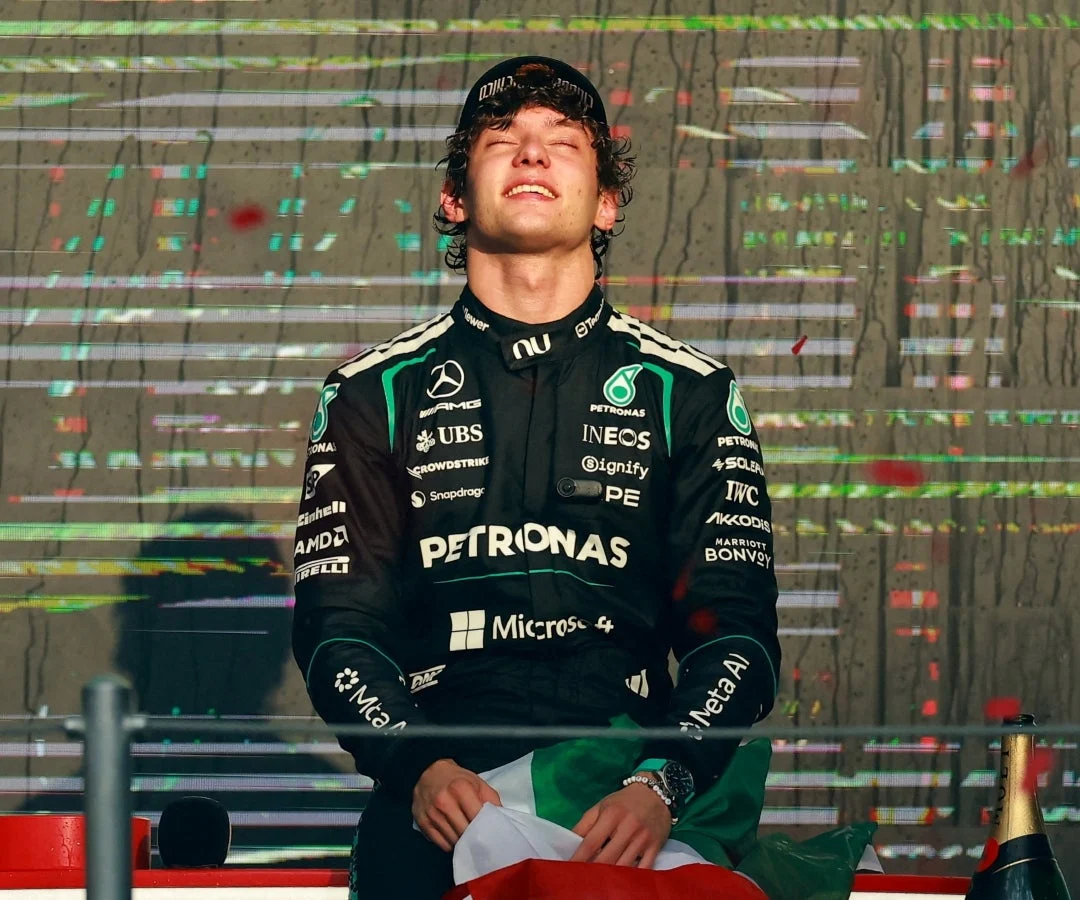
MEXICO CITY — In a milestone that will reverberate through the annals of motorsport history for generations, Andrea Kimi Antonelli etched his name alongside the immortals of Formula 1 on Sunday afternoon. Driving for the Mercedes-AMG Petronas F1 Team, the sensational 20-year-old Italian secured the 20th World Drivers’ Championship of his burgeoning career with a masterclass in composure, finishing third in a chaotic, red-flagged, and drama-soaked Mexican Grand Prix at the Autódromo Hermanos Rodríguez.
At precisely 20 years and 68 days old, Antonelli shattered a record that had stood for over a decade. He surpassed the previous benchmark set by German maestro Sebastian Vettel, who was 23 years and 134 days old when he claimed his maiden world title with Red Bull Racing in 2010. Furthermore, Antonelli’s triumph ends a staggering 73-year championship drought for Italy, becoming the country’s first World Drivers’ Champion since the legendary Alberto Ascari last claimed the crown in 1953.
With three rounds remaining in the grueling global calendar, Antonelli’s third-place finish elevated his unbeatable points tally to an insurmountable 119-point lead in the Drivers’ Standings. While Red Bull’s Max Verstappen claimed a brilliant victory under the intense altitude of the Mexican capital, and Ferrari’s Lewis Hamilton fended off fierce internal pressure to secure a hard-fought second place, the afternoon unquestionably belonged to the young prodigy from Bologna.
Main Facts: A Historic Milestone at High Altitude
The primary narrative of the Mexican Grand Prix was the coronation of a new king in motorsport’s premier tier. Entering the weekend needing only a solid points haul to slam the door on his remaining championship rivals, Antonelli approached the weekend with a maturity that belied his tender years.
Operating under the rarified air of Mexico City’s Autódromo Hermanos Rodríguez—situated 2,285 meters above sea level—the Mercedes charger navigated a race defined by attrition. Max Verstappen drove an immaculate race from the front for Red Bull, capitalizing on chaos to secure another maximum points haul, while Lewis Hamilton delivered a stellar performance for Ferrari to finish second after starting from pole position.
However, all eyes remained fixed on the silver-and-turquoise Mercedes of Antonelli. Needing to outscore or maintain a specific margin over his teammate George Russell and the chasing pack, Antonelli drove with the tactical acumen of a seasoned veteran. When the checkered flag dropped, sealing his third-place finish, the championship mathematically swung out of reach for the rest of the grid.
In the constructors’ and drivers’ sub-plots of the day, Charles Leclerc crossed the line fourth in his Ferrari, followed by the outgoing world champion Lando Norris (McLaren) in fifth, and George Russell—whose championship aspirations evaporated with a sixth-place finish. Oscar Piastri took seventh for McLaren, ahead of Franco Colapinto (Alpine), Liam Lawson (Racing Bulls), and Pierre Gasly, who rounded out the points-paying positions in tenth.
Chronology of Chaos: A Race of Red Flags and Resilience
The 71-lap encounter at the Autódromo Hermanos Rodríguez will long be remembered as one of the most tumultuous and unpredictable Grands Prix of the modern era, setting a theatrical backdrop for Antonelli’s coronation.
The Start and Early Drama
The afternoon began with Lewis Hamilton converting his hard-earned pole position into the lead for Ferrari, leading a charging pack down into Turn 1. However, the high-altitude conditions immediately began to strain power units and brake cooling systems across the grid. The race’s rhythm was quickly shattered by the deployment of the first Safety Car following a multi-car squabble in the midfield, neutralizing Hamilton’s early gains and bringing Verstappen immediately into striking distance.
The Turning Point: The 33-Minute Red Flag
The defining moment of the race arrived past the halfway mark. With 25 laps remaining of the scheduled 71, a series of high-speed incidents and mechanical failures triggered a catastrophic pile-up, forcing race control to throw the red flag.
Cars were brought to a halt in the pit lane, initiating an agonizante 33-minute suspension. Mechanics scrambled frantically under strict parc fermé conditions, while drivers stepped out of their cockpits to catch their breath. For Antonelli, sitting comfortably within the podium positions, those 33 minutes tested his psychological endurance. Tension mounted in the Mercedes garage, but the young Italian used the interval to center himself, conversing calmly with his engineers.
The Sprint to the Finish
When the race resumed with a rolling start, the chaos resumed instantly. Verstappen seized the initiative, expertly managing his tires to pull away at the front. Behind him, a ferocious, wheel-to-wheel intra-team battle erupted at Ferrari between Hamilton and Charles Leclerc. The two red cars traded paint in a hair-raising moment, but Hamilton ultimately prevailed to secure second place.
Antonelli, meanwhile, kept his nose clean. Avoiding the debris, steering clear of the two Safety Car periods that punctuated the restart phases, and managing his Pirelli rubber with sublime precision, he brought his Mercedes home safely in third place. As he crossed the finish line, the relief and euphoria broke through his radio transmission.
Supporting Data: The Anatomy of a Record-Breaking Season
To truly comprehend Kimi Antonelli’s championship, one must analyze the statistical dominance and sheer resilience that characterized his campaign.
The Championship Standings Shift
With his third-place finish in Mexico, Antonelli mathematically sealed the title, boasting a 119-point cushion that cannot be bridged in the remaining races. The shake-up behind him was equally dramatic:
- Max Verstappen (Red Bull): Climbed to second place in the World Drivers’ Championship following his commanding victory in Mexico.
- Lewis Hamilton (Ferrari): Cemented third place in the standings after a consistent run of podium finishes in the latter half of the season.
- George Russell (Mercedes): Dropped to fourth place, 130 points behind his teammate Antonelli, after a weekend where victory was required to keep his dwindling title hopes alive.
Comparing the Titans: Vettel vs. Antonelli
| Metric | Sebastian Vettel (2010) | Kimi Antonelli (Current) |
|---|---|---|
| Team | Red Bull Racing | Mercedes-AMG Petronas F1 Team |
| Age at First Title | 23 years, 134 days | 20 years, 68 days |
| Championship Lead Secure | Season Finale (Abu Dhabi) | 3 Rounds Remaining (Mexico City) |
| Historical Significance | Youngest champion of the V8 era | Youngest champion in F1 history; First Italian champion since 1953 |
Antonelli’s stellar campaign has been defined by an uncanny ability to extract maximum points from difficult weekends, showcasing a racecraft that has left pundits and rivals in awe.
Official Responses: Tears, Tributes, and Tremendous Joy
The emotional weight of the achievement poured out over team radios and in the media pen immediately following the race.
As Antonelli crossed the finish line, his race engineer, Peter "Bonno" Bonnington—historically known for guiding Lewis Hamilton through his championship years—came over the radio with a voice cracking with emotion:
"Let’s go, Kimi! World Champion!"
Through tears of joy, the young Italian gasped back:
"We did it, thank you so much!"
Upon stepping out of his Mercedes W15, Antonelli was immediately swarmed by his parents and sister, wrapped in emotional embraces before his mechanics hoisted him up amid chants and roaring applause.
Addressing the capacity Mexican crowd from the podium, wrapped tightly in an Italian flag and preparing to spray champagne, Antonelli confessed his disbelief:
"I’m speechless, I’m trying to process what just happened," Antonelli told the adoring grandstands. "It has been an incredible season, and sharing this podium with Max and Lewis is truly surreal. I look forward to many more battles in the future with them."
Reflecting on the psychological weight of the weekend, he added:
"This weekend I felt a bit more tension than usual, but I am so happy that we got it done. Now we can finally just enjoy the rest of the season."
Max Verstappen, showing the gracious sportsmanship of a four-time champion, was quick to praise his new peer:
"Kimi has been phenomenal all year. To achieve what he has done at just 20 years old is remarkable. Formula 1 is in very safe hands with drivers like him."
Implications: The Dawn of a New Era in Formula 1
Kimi Antonelli’s historic championship triumph is not merely a personal milestone; it marks a watershed moment for the sport of Formula 1.
The Changing of the Guard
For over a decade, the sport has been dominated by veterans and generational giants like Lewis Hamilton, Max Verstappen, and Fernando Alonso. Antonelli’s title—alongside the rising prominence of drivers like Lando Norris, Charles Leclerc, and Oscar Piastri—cements the definitive arrival of a new generation. At just 20 years old, Antonelli has time on his side to rewrite almost every major statistical record in the sport’s seven-decade history.
Mercedes’ Strategic Triumph
For the Mercedes-AMG Petronas F1 Team, this championship validates a bold, forward-looking driver management strategy. Placing their faith in Antonelli to step into a leading role has paid astronomical dividends. Team Principal Toto Wolff’s long-term vision has been vindicated, proving that the Silver Arrows possess both the technical prowess and the driver lineup to dominate the current regulatory era and look ahead seamlessly to future technical revolutions.
A Renaissance for Italian Motorsport
In Italy, the reaction has been nothing short of rapturous. Tifosi across the peninsula are celebrating their first World Drivers’ Champion since Alberto Ascari in 1953. While Antonelli drives for a German manufacturer, his roots in Italian racing culture—rising through the grueling karting and junior formulas in his homeland—have ignited a massive surge in motorsport participation and fandom across Italy.
As the Formula 1 paddock packs its bags and prepares to head toward the final stretch of the season, the narrative has fundamentally shifted. The championship is decided, the records have been rewritten, and a new global icon has been born. Kimi Antonelli is not just the future of Formula 1—he is its present.