
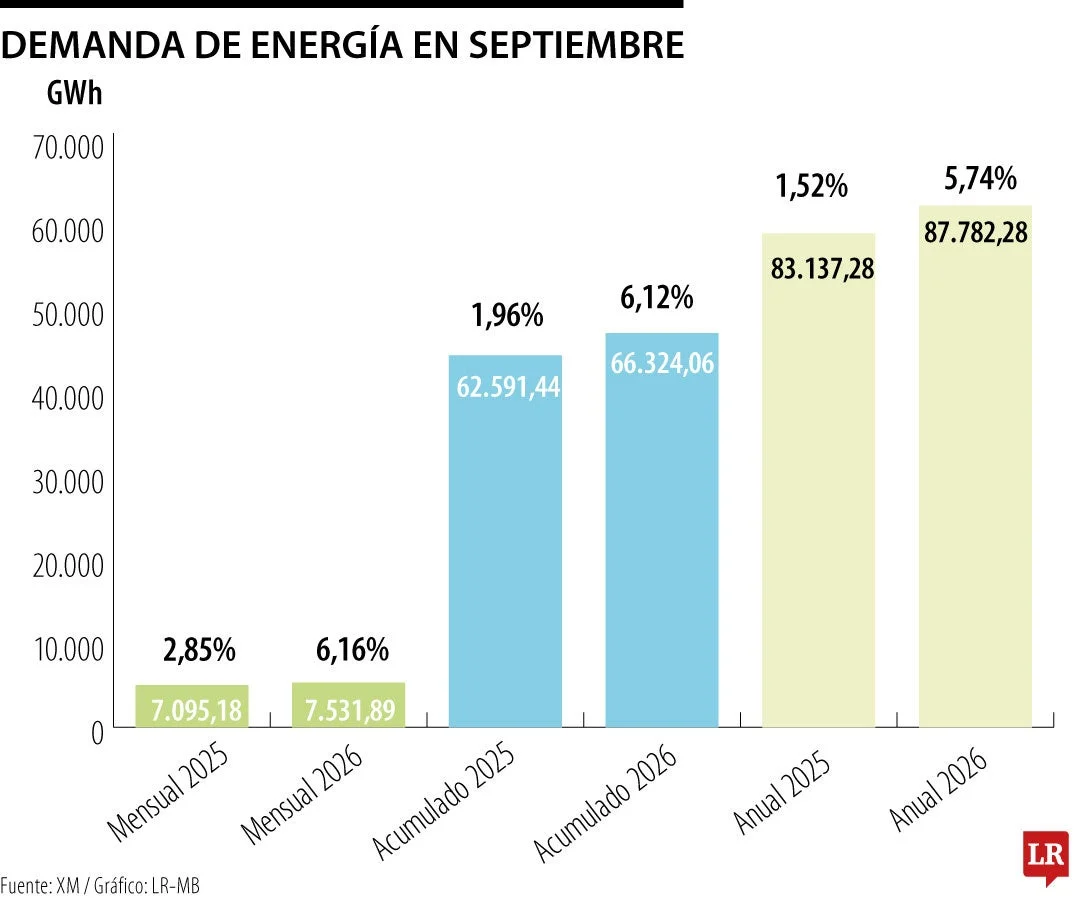
BOGOTÁ — Driven by soaring residential consumption and the early onset of thermal anomalies associated with the El Niño phenomenon, Colombia’s electricity demand experienced a notable upward trajectory in September 2026. According to the latest official report published by market operator XM, total electricity demand nationwide expanded by 6.16% compared to the same month in 2025, reaching a cumulative 7,531.89 gigawatt-hours (GWh).
While households and small-scale commercial establishments turned up air conditioning and cooling systems to combat unprecedented heat, the industrial and large-scale commercial sectors moved in the opposite direction, registering a slight contraction. The divergence highlights a shifting economic and climatic landscape across the South American nation, placing acute focus on the resilience of the National Interconnected System (SIN).
Main Facts and Figures
The September 2026 report from XM—the entity responsible for coordinating the operation of the SIN and administering the Wholesale Energy Market—presents a detailed breakdown of how power was consumed across the country during the ninth month of the year:
- Total Monthly Demand: Reached 7,531.89 GWh, representing a 6.16% increase year-over-year.
- All-Time Consumption Peak: On September 18, 2026, Colombia shattered previous records by hitting a historic daily consumption high of 266.56 GWh.
- Year-to-Date Growth: Between January and September 2026, total cumulative demand grew by 6.12% compared to the same period in 2025.
- Regulated Market (Households and Small Businesses): Surged by 8.95% annually, adding an extra 434.36 GWh of consumption.
- Non-Regulated Market (Industry and Large Commerce): Contracted by 0.58%, dropping 12.7 GWh compared to September 2025.
- Regional Hotspot: The Department of Guaviare led the country in regional growth, posting a staggering 14.43% increase in electricity demand.
Chronology of the Event: The Onset of El Niño and September Trends
The dynamics governing Colombia’s power grid in September cannot be understood without examining the meteorological shifts that began taking shape at the end of the third quarter of 2026.
Early September: Meteorological Anomalies Take Hold
As September commenced, meteorological agencies and XM’s monitoring teams detected positive temperature anomalies averaging close to 1 °C across large swathes of the Colombian territory. Unlike standard seasonal transitions, these early shifts signaled the preliminary phase of a warming El Niño cycle.
Mid-September: The Record-Breaking Heat Spike
By the second week of the month, the thermal pressure intensified significantly, particularly in coastal and valley regions. Riohacha (La Guajira) and the Valle del Cauca department recorded temperature spikes exceeding 2 °C above historical climatological averages. Meanwhile, departments such as Caquetá, Vichada, and Guainía registered anomalies hovering around 1.5 °C.
This sustained atmospheric heating culminated on September 18, 2026, when residential and commercial air-cooling loads drove the country to an all-time historical high of 266.56 GWh consumed in a single 24-hour window.
Late September: Consolidation of Sectoral Divides
As the month drew to a close, data processing by XM—which applies a weighted methodology to account for the varying number of weekdays, weekends, and holidays—revealed a stark dichotomy. While residential users sustained high baseline consumption due to lingering heat, heavy industry and commercial enterprises moderated their power uptake, stabilizing the grid’s load curves heading into October.
Supporting Data: Sectoral Breakdown and Regional Performance
A deeper dive into XM’s dataset reveals profound structural differences between how everyday citizens and heavy industries consumed electricity during September 2026.
The Regulated Market: A Residential Surge
The regulated market, which primarily comprises residential homes, municipal services, and small businesses, was the absolute engine of growth for the month. Consumption in this segment skyrocketed by 8.95%, translating to 434.36 GWh of additional energy compared to September 2025. The data underscores how vulnerable domestic cooling needs are to rising ambient temperatures, directly impacting household utility bills and urban energy grids.
The Non-Regulated Market: Industrial Contraction
Conversely, the non-regulated market—representing large-scale industrial plants, factories, and major commercial enterprises—saw a minor contraction of 0.58%, shedding 12.7 GWh year-over-year.
Despite the overall dip, specific economic sectors within the non-regulated umbrella maintained heavy footprints:
- Manufacturing Industries: Dominated the non-regulated segment with 899.05 GWh consumed, accounting for 40.96% of the entire industrial market.
- Mining and Quarrying: Secured second place with 634.89 GWh, representing 28.93% of total non-regulated demand.
- Construction: While commanding a smaller share of total demand (0.51%), the construction sector posted the highest percentage growth within commercial non-regulated activities, expanding by 12.79% (an increase of 1.27 GWh).
Regional Distribution and Growth Rankings
Geographically, the expansion of energy demand was widespread, though certain departments outpaced the national average by wide margins:
- Guaviare: Ranked first in relative growth with a 14.43% surge (1.048 GWh additional).
- Tolima, Huila, and Caquetá: Combined for a 10.66% increase.
- Valle del Cauca: Grew by 8.41%.
- Chocó: Advanced by 8.29%.
- Caribbean Region: Expanded by 8.24%.
In terms of sheer volume, however, the heavyweights remained the most populous economic zones:
- Caribbean Region: Led absolute consumption with 2,212.7 GWh.
- Central Region: Followed closely with 1,722.40 GWh.
- Antioquia: Recorded 1,032.78 GWh (amid a regional growth rate of 6.36%).
Other regions registered more moderate gains: the Southern region grew by 5.48%, the Eastern region by 4.35%, the Coffee Triangle (Caldas, Quindío, and Risaralda) by 3.75%, and the Central region posted the most modest year-over-year variation at 2.63% (44.59 GWh additional).
Official Responses and Operational Oversight
The release of the September 2026 data prompted immediate commentary from energy sector authorities, emphasizing the delicate balance required to maintain grid stability during climate transitions.
XM reiterated its core mandate as the administrator of the Wholesale Energy Market and the coordinator of the SIN. In official statements accompanying the report, the operator stressed that maintaining the reliability and quality of the electrical service remains paramount, especially as climate phenomena like El Niño introduce volatility into consumption patterns.
"The anomalies observed—averaging close to 1 °C nationwide and exceeding 2 °C in vulnerable coastal and valley zones—directly correlate with the early intensification of El Niño’s warm phase," XM noted in its technical brief. "Our monitoring models account for day-type weightings to ensure that commercial days, weekends, and holidays are accurately balanced, giving us a true reflection of structural demand shifts rather than calendar anomalies."
Energy analysts and regulatory bodies have also pointed out that while the grid successfully absorbed the historic 266.56 GWh peak on September 18 without major incidents, ongoing vigilance is required. Reservoir levels, thermal backup generation capacity, and energy efficiency campaigns will serve as the primary defensive lines if El Niño intensifies further in the coming months.
Implications for Colombia’s Economy and Energy Future
The September 2026 electricity demand report carries profound implications for macroeconomic policy, environmental planning, and industrial strategy in Colombia:
1. Household Pressures and Energy Affordability
The nearly 9% surge in the regulated market signals that residential consumers are bearing the immediate brunt of climate variability. Higher electricity consumption driven by cooling needs directly translates to heavier financial burdens on working-class and middle-class households. This dynamic could reignite public debates regarding utility tariff structures, government subsidies, and the accessibility of energy-efficient appliances.
2. Industrial Competitiveness and Economic Signals
The contraction in the non-regulated industrial and commercial sector (-0.58%), while modest, warrants careful observation. A cooling industrial demand can sometimes serve as a lagging indicator of cautious capital investment, localized supply chain adjustments, or efficiency optimization by manufacturers seeking to cut overhead costs amid fluctuating economic conditions. However, the robust growth in construction-related energy demand suggests localized pockets of resilience and ongoing infrastructure development.
3. Climate Vulnerability and Grid Preparedness
As El Niño transitions into a fully established warm phase, Colombia’s energy matrix faces a familiar test: balancing hydroelectric generation capacity with thermal backup. The fact that the country hit an all-time demand high in September—months before the traditional peak of the dry season—demonstrates that baseline power requirements are shifting upward permanently due to changing weather baselines.
Ultimately, XM’s September 2026 report serves as both a milestone and a warning. It underscores the undeniable intersection between climate change, consumer behavior, and national energy security, reminding policymakers that Colombia’s infrastructure must continually evolve to meet the challenges of a warming world.